

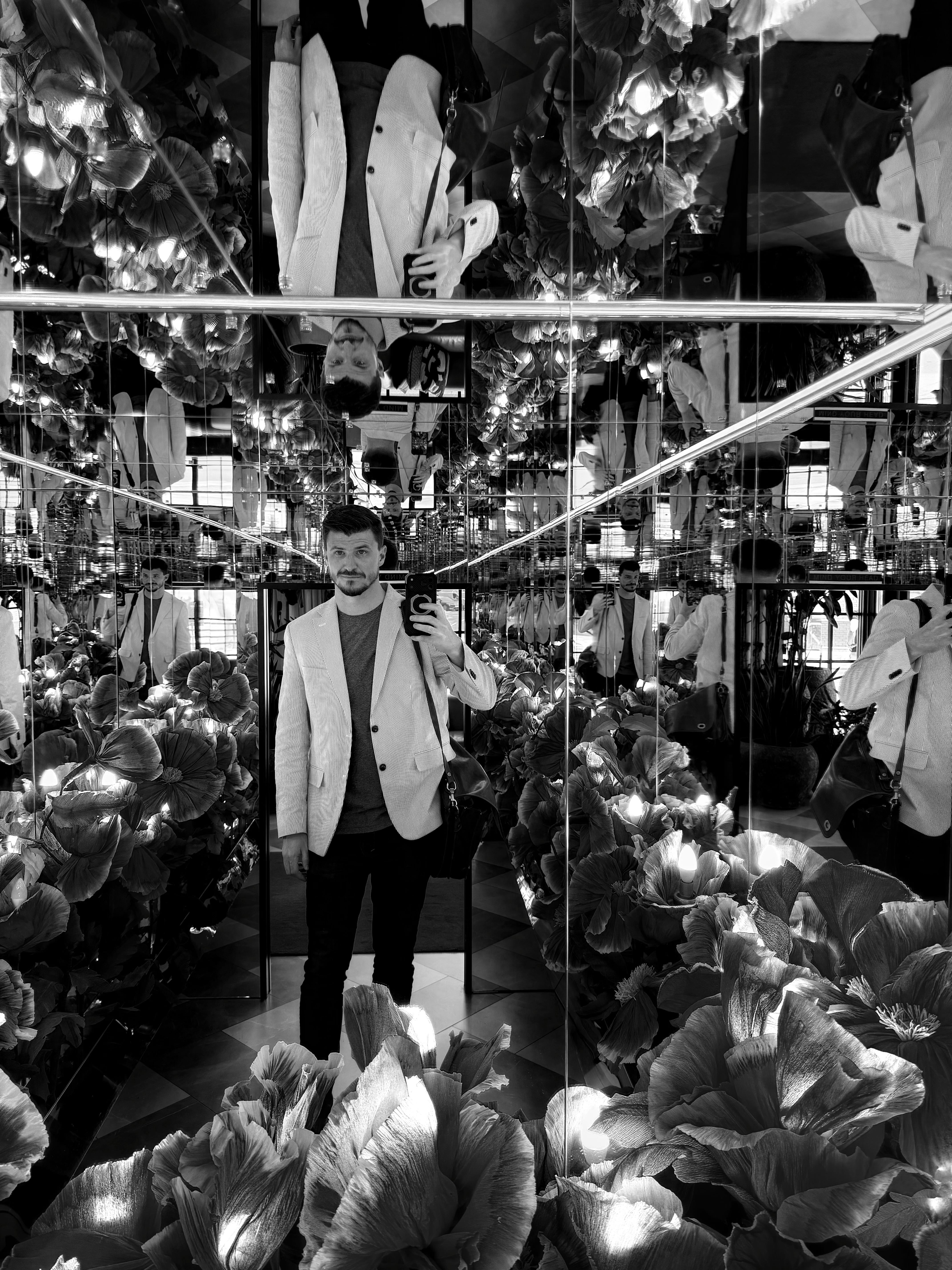
Quick note: This started as a LinkedIn post but grew into something longer. And, yes, I’ll be back soon with the Making the Party Fun Again series about the state of the film and TV ecosystem. Stay tuned.
A friend called me out by saying, ‘Your LinkedIn content—all 9 paragraphs of it [a subtle tease at my lack of brevity]—would be better without that AI slop imagery. You don’t need it.’
Shocked and dismayed, I countered that I never thought of it as ‘slop’ (comparable to other posts I’ve seen out there), but as a complement to my blog and social output. I view it as a hook; a visual grab. I refine said images through carefully worded prompts and/or by layering photography and prints as a means of capturing ideas expressed in the prose. Acknowledging my main focus is always the writing, do my image development attempts have any merit? Is it dressed-up ‘slop’ at best?
More importantly, what does it say about the expectations placed on creators in a crowded content ecosystem and the role tech like AI can play (or not) in advancing their activities to engage demanding audiences?
Let’s dig in…
First, some examples.
Fair warning: I picked what follows, which means I draw on my own work as well as what I believe to be aptly representative of content I’ve seen elsewhere. Just a friendly FYI.
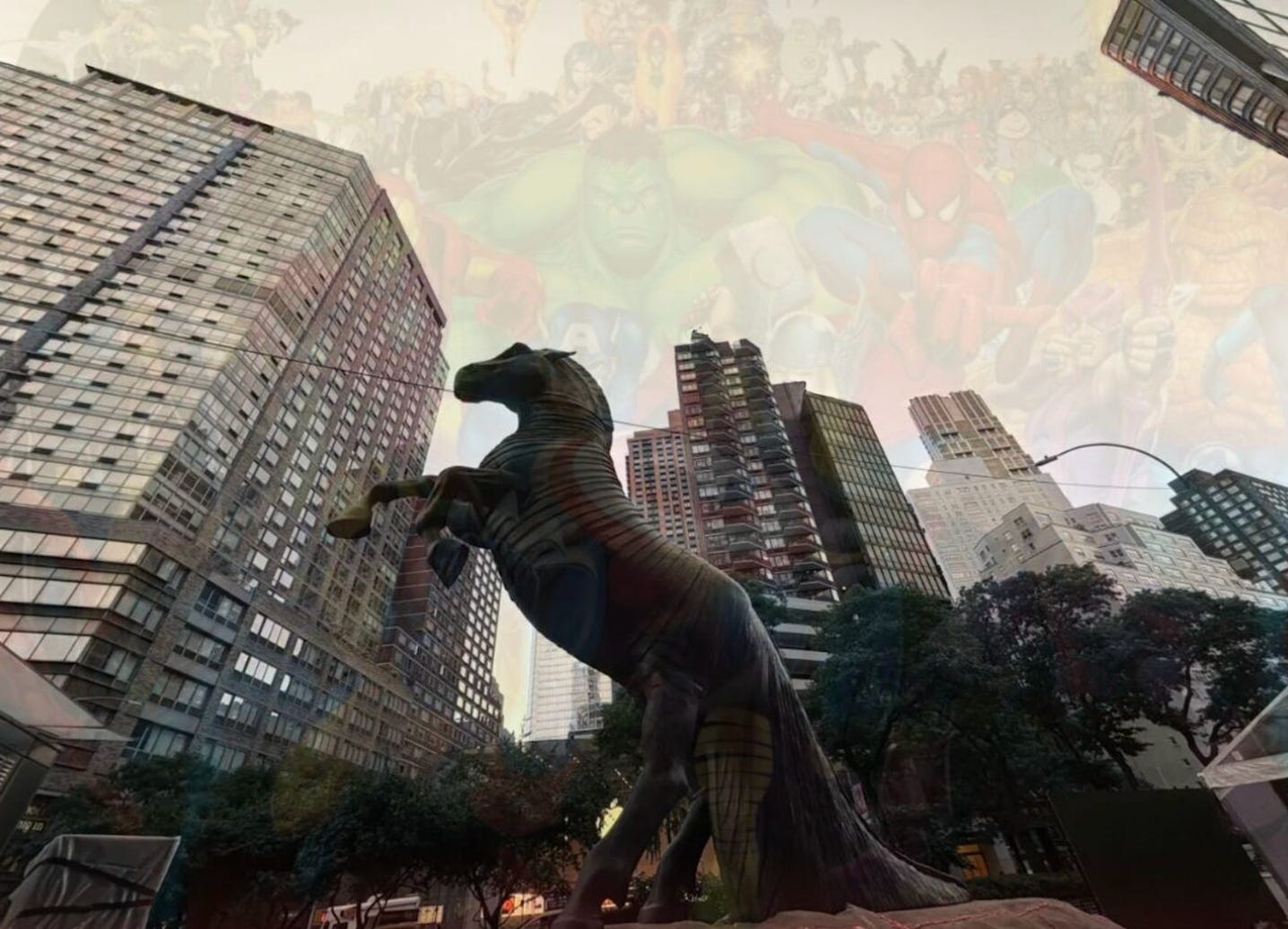
The image below comes from one of my recent LinkedIn posts discussing The Odyssey (2026). It features an AI-generated horse statue similar to what’s seen in Christopher Nolan’s film. The imposing figure pierces the ‘creative ceiling’ dominated by comic book fantasies. I aimed to convey how the epic’s technical achievements and special effects raise the stakes in modern big-budget productions previously overrun with excessive CGI (as exemplified by the Marvel Universe).
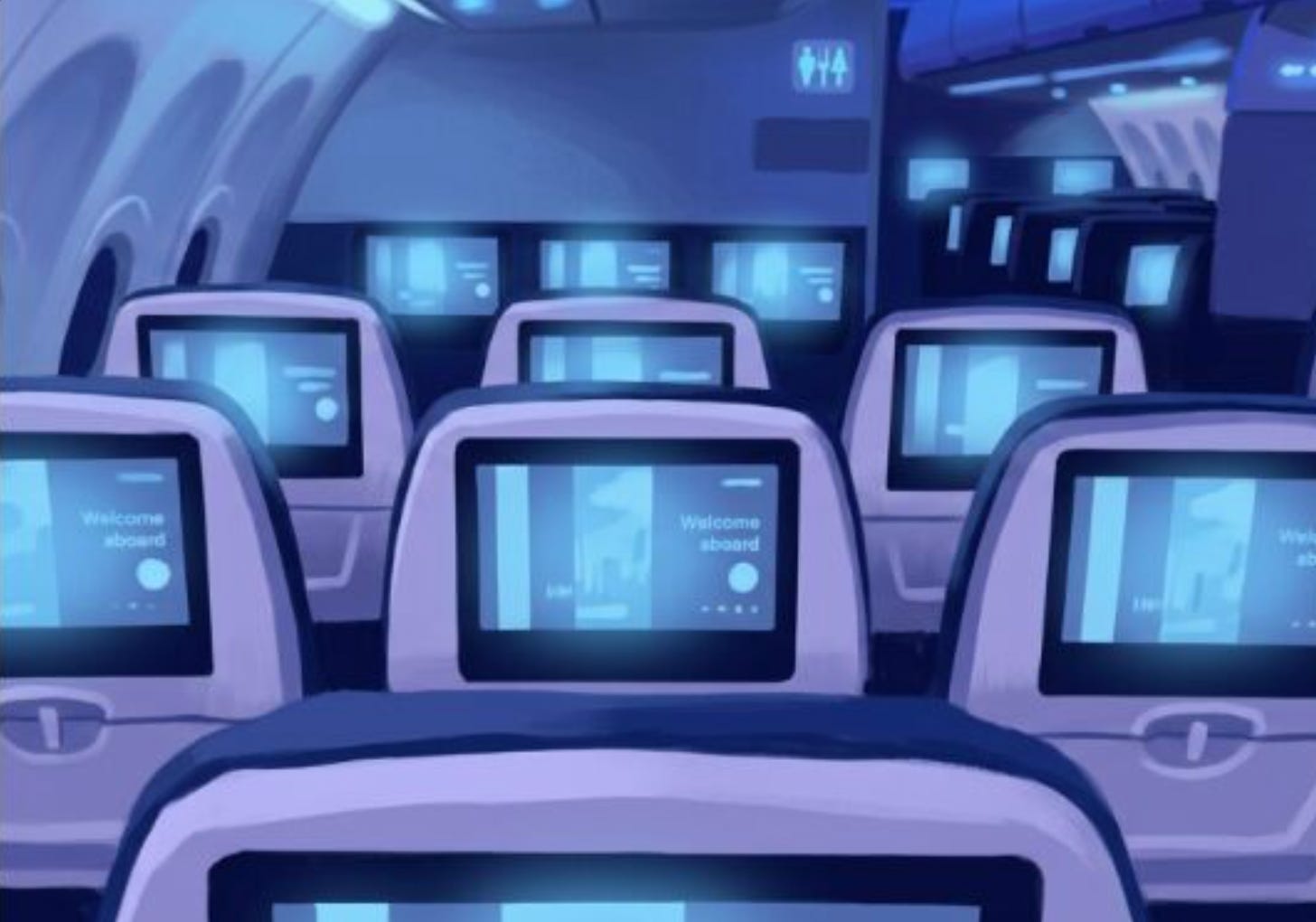
Next is another, simpler AI-generated abstraction derived from a real image featuring backseat airplane screens. This accompanied a LinkedIn post I wrote about how in-flight entertainment is a useful metaphor and case study for viewer media selection preferences (“Anyone producing or delivering film and TV should be thinking in these terms, because everything feels ‘in flight’ now. Depending on your intent, does the work pass the time as escape and/or expand one’s perspective? And if you’re a platform: how are you encouraging someone to hit play, rather than just handing them more to refuse?”). It attempts to provide a visual representation suitable for the subject matter, while altering the scene just enough to encourage a rethink of in-flight entertainment as an encapsulation of viewing habits more broadly.
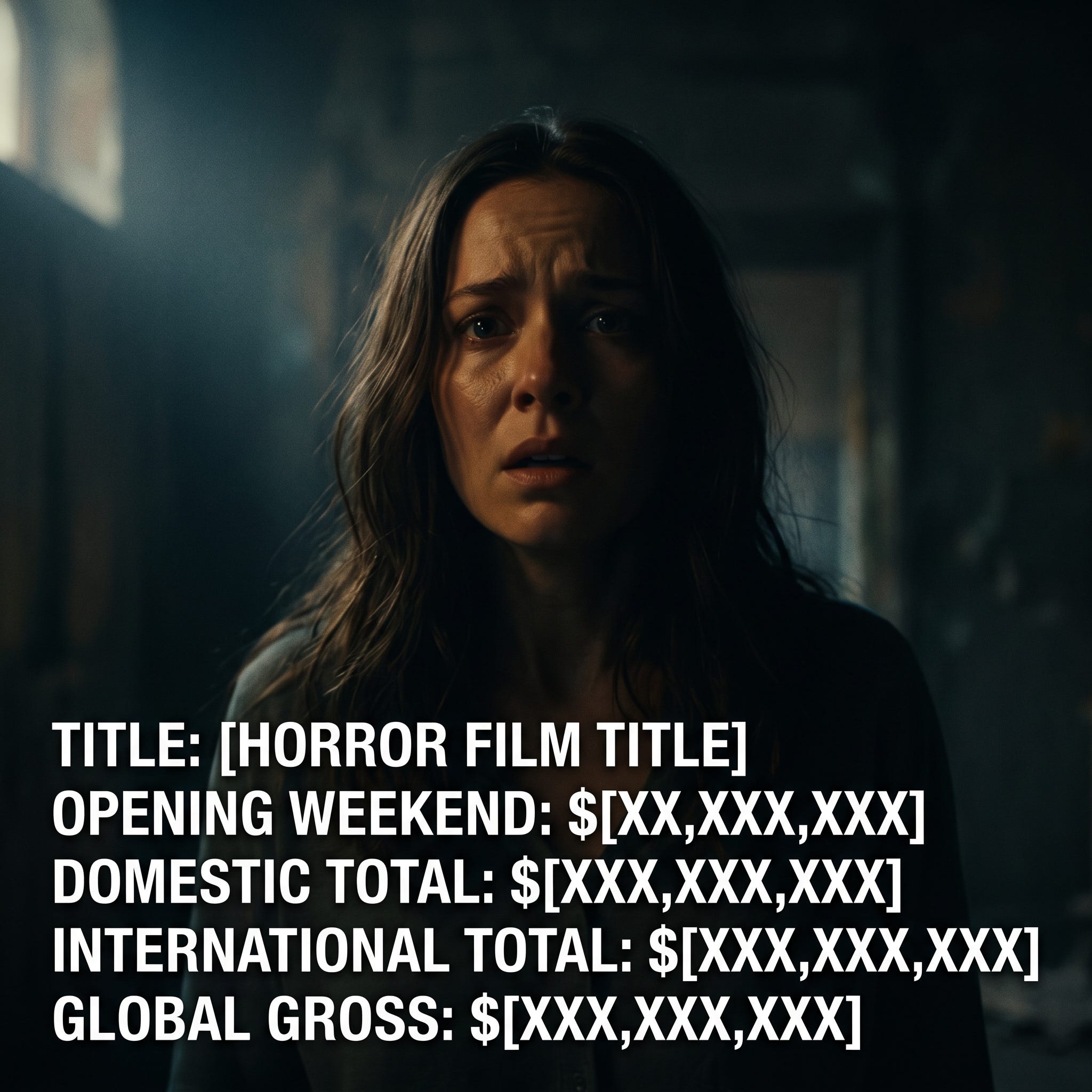
The following final image is not included in one of my posts, nor taken from a live LinkedIn post. I didn’t want to pillory anybody’s actual content. Regardless, I think it is an example of an AI-generated piece I see often: an uncannily ‘realistic’ image with basic information relevant to the post (e.g., ‘horror film performing well at the box office’). It’s not terrible by any means, but it’s typical for the platform and arguably unimaginative in its design. There are worse examples out there, for sure, but I think this challenges notions of what’s acceptable or not. Should it be harshly labeled as ‘slop’? Yes, I’d argue, IF you think it has no conceptual value, registers as superfluous and/or diminishes the credibility of the post’s text content.
I leave it to your judgement as to whether any of these images prove effective, let alone if I succeed relative to other writers and analysts in the space. Please know that I do not think my attempts at presenting a piece with visual components should be praised as the exemplar. No matter how much thought and care I invest in such visual aids, I view my well-intentioned usage of AI as merely practical and functional.
Regardless, I understand the tension. I can almost hear designers and artists cursing my name. I’ve worked closely with these professionals for the majority of my career, and I admire the amount of thought and craft they pour into their work. I just don’t have any of that talent (ha). So, I’m trying to do my best with what I have at my disposal while publishing content across several platforms at a regular clip.
In short, there’s an issue here beyond simple image selection for social and blog posts. It’s a larger struggle pitting creator capacity and audience demand against standards of authenticity.
Consider some figures on this front. We Are Social/Meltwater reports US and UK consumers spend roughly 35-42 hours per week across all media offerings, and Ampere Analysis surveys show users engage an average of 11.5 platforms per week/per user (e.g., social media, long-form online video, podcasts, music, reading, and video games).1,2 People also seek out more tailored and affordable content options. According to Antenna, specialty SVOD usage growth has held steady at 14% YoY compared to Premium SVOD growth, estimated at 6%. More economical and fan-focused offerings continue to grow and retain users. Even large aggregators like Amazon Prime Video Subscriptions, or channels, account for reportedly 67% share of Specialty SVOD Gross Subscription Additions (as reported by the end of Q2 ‘26).3 Consider these stats, too, alongside the number of TikTok and Instagram personalities each user follows, scanning through their feeds to unlock a quick serotonin bump.
This means that every provider and creator, no matter how established or new on the scene, competes against each other. Delivered content must present as distinct and worthy of inclusion in a fan’s or follower’s multiplatform media refuge. Audiences are overwhelmed but expecting specialization; they want something manageable and intimate. But even when a platform or expert creator expands reach and algorithmically zeroes in on its users, it doesn’t necessarily maximize attention. True engagement remains elusive. Lady X can watch, scroll, eat, and daydream at the same time. To what degree does anyone in our era seriously process what they read/watch/hear daily? In such an ecosystem, consumers and creators struggle to focus and find each other, much less achieve any kind of lasting connection or profound resonance.
AI could serve as a productive tool in this complicated moment. Users can employ AI to help expedite research, planning and basic tasks. This frees up hours to better enjoy and explore content. Creators implement AI solutions to cut down on demanding processes and production execution. They instead emphasize pursuing core artistic objectives, rather than drowning themselves in marketing and administrative work. This shift from overwhelming tedium to previously neglected areas of value applies to global studios and individual creators alike. The only difference is scope and scale. That’s the theory, anyway.
In practice, AI services and tools are already prevalent. Automated workflows, drafted planning documentation, batch editing, data analysis and distillation…all is now accessible and performed instantly.
I personally benefit from using Claude, in particular, to serve as an editor and sanity check. Not a final say, but to act like a capable reader, or assisted intelligence, alongside trusted colleague reviewers to advise on grammatical correctness and prose clarity. It helped on this piece by suggesting helpful edits and, specifically, proposing I open the piece with my accuser’s critique (i.e., the current version). For other pieces, I have also drawn on image generation tools like Midjourney and Gemini. Again, experimenting with different prompts, I’ve produced and blended images to prepare artwork I deemed relevant. It’s an admittedly fun creative exercise that enables me to redirect a greater portion of my efforts to writing—and that’s the ultimate goal.
However, there’s that slop accusation.
If I attempted to design all imagery myself or include my own photography (as I did for the opening of this entry) or root around every time for the perfect existing image, it would further drain my already limited time and/or money (if licensing is involved).
Still, my finger-pointing friend is not wholly wrong…maybe even, I concede, partly right. I include the images to hopefully yield greater interest and—yes—reach. Would as many people read without the image present?... I’m not so sure.
I’m also not alone in these dilemmas. Yes, there are benefits to new technologies. However, many lash out against tools like AI that help us produce more but leave us feeling hollow, as if we’re losing the creative human skills we’ve cultivated over millennia. It’s why you see people returning in droves to analog, and industry unions demanding disclaimers for any AI-generated content.4,5 People want to preserve their human creative ability and cultural integrity in a saturated world.
Market realities remain, though. Will people pay attention if you’re not everywhere all the time? Many would say no. Note as well that what seems ‘niche’ could just be content and/or a creator with a limited footprint spread thinly but widely across many platforms in an attempt to get some traction, somewhere. That’s the rub. What if you can’t be discovered, no matter the quality of your content, unless you engineer a widely distributed, multisensory experience…without a full staff to lean on? And, if streaming platforms pulling in billions are losing eyeballs to an ever more fragmented audience, then how can a single individual in a sea of creators stand a chance to progress, let alone earn a living?
Or, what is the ideal formula of authenticity, talent, tenacity, and luck to succeed?... It gets slippery, fast.
Time, money and attention are scarce. There’s pressure to seek one and forfeit the rest. I try to fathom a species-wide crash in attention and optionality to normalize something like an undivided human experience. That’s something akin to a reboot. An unlikely occurrence.
Questions multiply at what seems a tipping point.
On my end, I will plan to do two things in earnest over the next two months:
Journal how I actually spend my time across different platforms. I’m curious how I compare with national and international averages. Given I’m also a distracted consumer, I’ll note what text and/or visuals draw me in most for 4-5 content examples across different platforms, likely Netflix, Tubi, Instagram, LinkedIn, and Substack.
Monitor and compare content effectiveness based on the use of AI tools, evaluating the impression and engagement performance (e.g., comments, likes) across 10 LinkedIn posts and 4 blog posts of the same length and posted at the same time based on usage of AI-generated images versus no included imagery. It’s admittedly not perfect; the difference in post/entry subject matter and other factors will influence readership. It’s also not A/B testing per se, but I think it will provide some data on what works versus not. I’ll also ask select readers to provide their input.
I’ll report back in the fall when I have some insights. Time to give it a go…
For starters, did you even stop to really read this post? If so, how and why?
Sources
“Digital 2026: In The U.S.” We Are Social and Meltwater, 2025, wearesocial.com/us/blog/2025/11/digital-2026-in-the-us; and “Digital 2026.” We Are Social and Meltwater, 2025, wearesocial.com/uk/blog/2025/10/digital-2026
“Breaking Down the Attention Economy.” Ampere Analysis, 2026, ampereanalysis.com/report/breaking-down-the-attention-economy
“State of Subscriptions: 1 in 3 U.S. Consumers Have Tried a Specialty SVOD.” Antenna, 2026, antenna.live/insights/q326-state-of-subscriptions-1-in-3-u-s-consumers-have-tried-a-specialty-svod
Sax, David. “Why Gen-Z Is Embracing Old Tech: Fighting the Algorithm With Analog.” The Hollywood Reporter, 2026, hollywoodreporter.com/music/music-features/gen-z-old-technology-1236663883
"Artificial Intelligence." SAG-AFTRA, sagaftra.org/contracts-industry-resources/member-resources/artificial-intelligence. Accessed 18 Aug. 2026.
This is the end. Want more?