

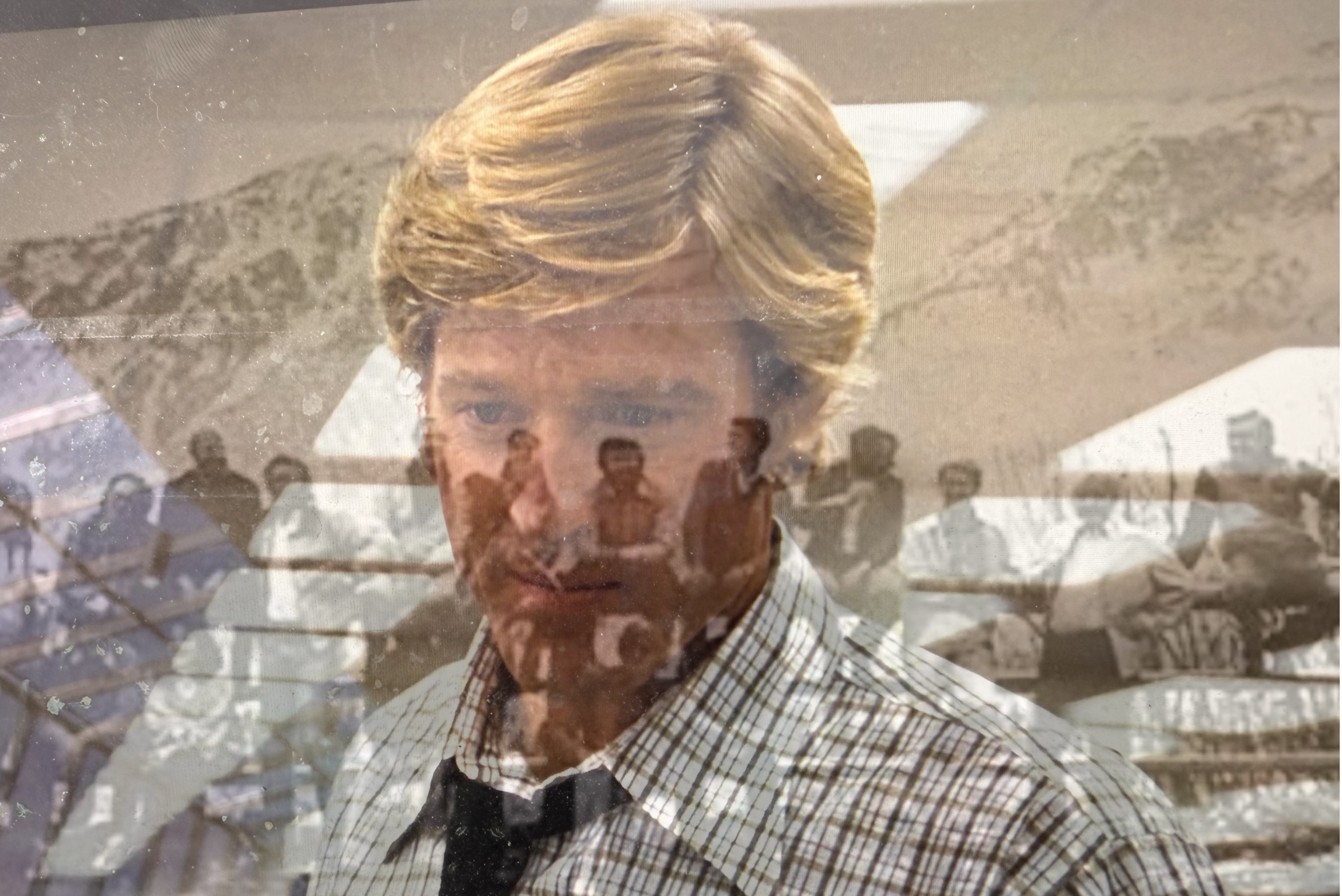
We’re in a busy newsroom—enormous, fluorescently lit. Reporters on deadline rush back and forth. The calendar on the wall tells us it will soon be the last quarter of the tumultuous 20th century before the onset of the fragmented 21st. Clacking typewriters sound like a steady downpour punctuated by harried chatter. Phones ring nonstop. Stacked printouts crowd desks, redlined paragraphs measure words spent and sleep unslept. This is a fact distillery. The pressure is constant. Putting out ‘the first draft’ of an unpredictable, addled history is not for the half-hearted or risk-averse. Most are unable or unwilling to separate leads from hearsay, truth from falsehoods. There’s an individual, though, who draws our attention. His hair is dusty blonde, his face strikingly handsome but worn and alert. His denim-colored eyes scan the commotion. He recognizes something wrong. He rises, calmly.
That individual is Robert Redford. He’s portraying Washington Post journalist Bob Woodward in All the President’s Men (1976). Directed by Alan J. Pakula, the New Hollywood-era classic is a fitting testament to the dynamic Redford, who also served as a producer instrumental in getting the movie made. In the scene above, Woodward catches a colleague ‘polishing’ his article draft without permission. He approaches the offending reporter, Carl Bernstein (Dustin Hoffman), and requests his draft back, but agrees to read the edited version. Bernstein defends his actions, but Woodward interrupts: “All right, yours is better,” he says. Woodward strides back to his desk, then returns promptly with a clutch of loose legal pad paper. He drops the pile in front of Bernstein. “If you’re going to do it, do it right,” he states simply. “Here are my notes. If you’re going to hype it, hype it with the facts. I don’t mind what you did; I mind the way you did it.”
Yes, this is a character in a movie. But it is a fiction informed by a commitment to honesty and integrity. The cinematic moment perfectly encapsulates the career and legacy of the late Robert Redford, a world-famous star turned film industry disruptor.
Striving for truth and value produces better work.
The way and reason you do things matter.
***
Many pieces have and will be written about the life and storied career of Robert Redford, who passed away on September 16, 2025, at age 89. One of Hollywood’s most sensitive and private leading men, he appeared in classics like Barefoot in the Park (1967), The Sting (1973), Three Days of the Condor (1975), The Natural (1984), and All is Lost (2013). He was also an accomplished director of such lauded films as Ordinary People (1980), A River Runs Through It (1993), and Quiz Show (1994).
His distinction came from an understated charisma and endearing but never cloying presence. This characterized his contributions as both an actor and director. He held forth as a quiet westerner with idol good looks imbued with wizened somberness that bordered on the mysterious. Though dashing enough to play Jay Gatsby, he seemed more at home in quiet retreats or the outdoor expanses he championed as a devoted environmentalist. These qualities remained constant whether he donned the pinstripes of a conman in Depression-era Chicago or the coarse beard of a 19th-century frontiersman struggling to stay alive.
Though I could further discuss Redford’s life and career—he was certainly an intriguing individual—I’ll leave that to other critics and biographers. What interests me here is how he leveraged celebrity to become one of the most transformational figures in the modern film industry by acting as a maverick turned mentor and agent for change. He devised a blueprint on how to produce opportunities for creators while forcing myopic executives to recognize a culture outside the echo chambers of Manhattan boardrooms and Hollywood backlots.
And it all began in Redford’s beloved American West. Drawing on his earnings from star-making roles in the 1960s, Redford purchased a ski area northeast of Provo, Utah. He named it “Sundance” after the character he played in Butch Cassidy and the Sundance Kid (1969), a movie about outlaws who rob trains owned by industrial tycoons. An active local community member, Redford collaborated in 1978 with the Utah Film Commission to serve as the first chairman of what was then called the Utah/United States Film Festival. In a nod to Redford’s persistent rebellious streak, the festival promised to help filmmakers develop projects outside the corporatized Hollywood system. The event would eventually move to Park City, Utah, fall under the control of Redford’s Sundance Institute, and take on the name of the Sundance Film Festival.1,2
Over the ensuing decades, the festival served as a vital beacon and incubator of independent film that quickly grew in scale and prestige. In 1985, the festival received fewer than 200 submissions, which would increase to 15,775 submissions by 2025.3,4 During that same timespan, event attendance surged as well. Small audience numbers in the hundreds would lead to a combined in-person and online viewership of more than 344,000 in 2025. As an event with a significant footprint in Utah, the 2025 festival alone registered $162.4 million out-of-state visitor spending while generating an estimated 2,697 jobs with $103.3 million in wages and over $21 million in state and local tax revenue.5
What was once essentially a small artist retreat had become a primary magnet of film culture carrying significant industry clout.
Though impressive, these stats pale compared to what Sundance has culturally and economically generated over the years when considering the films picked up at the festival for distribution. It is astonishing to review some of the filmmakers and movies spotlighted for the first time at Sundance through the decades. The list reads like a master’s course syllabus on modern American cinema.
The festival launched careers spanning generations, from early discoveries like Steven Soderbergh with sex, lies, and videotape (1989) and Quentin Tarantino’s Reservoir Dogs (1992) to breakouts like Ryan Coogler’s Fruitvale Station (2013), Damien Chazelle’s Whiplash (2014), and even recent Oscar winners like Siân Heder’s CODA (2021). The breadth is staggering: art house auteurs, genre innovators, and mainstream crossover successes all found their first major showcase at Sundance.3,6
Such multigenerational-defining output aligned with Redford’s ambition to, in his words, make the world “safe for artistic diversity. If you want to bring about real, sustained change, you have to be constantly aware that you are not just taking care of yourself. You end up using whatever power you’ve gained to take care of yourself and others by creating a category that others like you can work in.”7
Redford made good on the bold gambit to leverage his fame as a launchpad for independent cinema. He expanded the notion of what a diverse film culture could encompass and generate if given the essential support and space to do so. As a result, filmmakers could forge their own path with greater confidence, tycoons in power notwithstanding. Redford, rather than accepting derivative Hollywood fare, helped set the standard for encouraging colleagues to craft original stories and advance fresh voices usually tamped down by the entertainment industrial complex.
It would have been easy for Redford to coast on movie stardom. Instead, he stood up and took action on what he believed: giving filmmakers a chance to produce groundbreaking, uninhibited work. He established a sense of place, home, and community where you could take on “projects that were different from the run of the mill.”7
The Sundance Kid and his little film festival were not interested in diluted vision. He went for it. Others joined in. They made history.
***
Praise aside, it is important to acknowledge that Sundance has faced criticism over the last several years for succumbing to what it set out to counter. Some claim the festival has become overly commercialized. Journalist John Cook described it as “an annual industry junket and trade show” rather than being about independent cinema.8
Redford himself addressed these issues in 2006: “Once the festival achieved a certain level of notoriety, then people began to come here with agendas that were not the same as ours.”8 A Utah State University study similarly concluded that “Hollywood studios have been able to infiltrate and commodify independent projects from the Sundance Film Festival” and that the festival “currently operates as a marketplace for films rather than an independent festival.”9 The grassroots origins of the festival and institute matured into a major acquisition arena, fundamentally altering Sundance’s character.
Additional issues have plagued the festival. Its remote, expensive Park City location is prohibitively priced for most moviegoers. The outsider filmmakers who once called Sundance home have been, according to observers, infiltrated by pretentious hipsters and celebrity seekers. There have also been complaints about insufficient attention paid to women filmmakers and artists of color.
In response, Sundance leadership has taken measures to address these problems, including the expansion of diversification initiatives. Notably, organizers recently announced a permanent move to Boulder, Colorado, starting in 2027. According to Sundance Institute Acting CEO Amanda Kelso, the relocation capitalizes on Boulder’s improved accessibility and reputation as an “art town, tech town, mountain town, and college town. It is a place where the festival can build and flourish.”10
When announcing the move, Redford’s team reinforced the Sundance ethos: “Change is inevitable; we must always evolve and grow, which has been at the core of our survival. [...] The move will ensure that the festival continues its work of risk-taking, supporting innovative storytellers, fostering independence, and entertaining and enlightening audiences.”10 It’s the same rebel mentality in action. If successful, it will amount to the Sundance Kid in spirit and his inheritors reimagining the next iteration of the festival and institute for a new generation.
***
Despite critiques over the years, however, there is little doubt about what the greater Sundance phenomenon says about Redford’s lasting influence. If anything, the constructive criticism leveled at the festival only shows that pursuing artistic integrity requires dogged, tireless effort. The sense of place, home and community Redford sought is not geographic at its heart—it’s an idea located wherever filmmakers test the boundaries of what a contemporary film industry can be as we navigate the radically changing media landscape.
This means reaffirming a dedication to independent-minded film and television. It means challenging corporate media decision-makers on what is financially viable while advancing the medium to reach audiences where they are—and where they never imagined they could go.
Pressing questions remain: Will filmmaker festivals and labs like Sundance become a countrywide network enhanced by online communities? Can partnerships with streaming and connected TV platforms ensure wider independent content distribution? Will digital creators discover storytelling vehicles that bypass traditional pipelines? Might audiences grow so bored with cookie-cutter intellectual property that the Sundance ethos becomes not just ‘nice to have’, but a cultural and commercial imperative?
What’s not in question is the profound impact of the Sundance Festival and Institute—both their years-long cultural reverberations and positive implications for the film and television industry going forward.
We should take our notes from Robert Redford, who understood what his character Bob Woodward knew in that raucous newsroom alive with confusion and possibility: it’s not just what you create, but how and why you create it. Let risk act as a catalyst. Be true to your voice. Support systems that don’t exploit and neuter but empower and nurture artists.
In a period of franchise filmmaking and algorithm-driven content, Redford’s legacy feels more vital than ever. The Sundance experiment proved that committed individuals can reshape an industry. The blueprint exists, ready for adaptation to the 21st-century media madhouse. Will people use it?
Sources
“Robert Redford and His Beloved Utah Canyon.” The New York Times, 18 Sept. 2025, www.nytimes.com/2025/09/18/us/robert-redford-utah.html.
“Sundance Film Festival | Robert Redford, Moving Pictures, Independent Films.” Britannica, 16 Sept. 2025, www.britannica.com/art/Sundance-Film-Festival.
“Festival History.” Sundance Institute, 2 Apr. 2025, www.sundance.org/festival-history/.
“Sundance Film Festival 2025 Announces Feature Film Lineup.” IMDb, 22 Sept. 2025, www.imdb.com/news/ni65005790/.
“2025 Sundance Film Festival Attendance Recap and Economic Impact Report.” Sundance Institute, July 2025, www.sundance.org/wp-content/uploads/2025/07/2025-Sundance-Film-Festival-Attendance-Recap-and-Economic-Impact-Report.pdf.
“Timeline.” Sundance Institute, 17 Sept. 2025, www.sundance.org/timeline/.
“Robert Redford Legacy.” Sundance Institute, 17 Sept. 2025, www.sundance.org/redfordlegacy/.
“Redford Defends Direction Of Sundance.” CBS News, 12 Feb. 2006, www.cbsnews.com/news/redford-defends-direction-of-sundance/.
Cottrell, Matt Dee. “The Question Concerning the Cooptation of the Sundance Film Festival: An Analysis of the Commodification of Independent Cinema.” Utah State University Digital Commons, 30 Nov. 2009, digitalcommons.usu.edu/etd/485/.
“Sundance Institute Announces Boulder, Colorado, as the New Home for the Sundance Film Festival Beginning in 2027.” Sundance Institute, 26 Mar. 2025, www.sundance.org/blogs/sundance-institute-announces-boulder-colorado-as-the-new-home-for-the-sundance-film-festival-beginning-in-2027/.
— Note on Imagery: Unless I’ve provided credits for images in these posts, please assume they are produced by GenAI tools. I am not a designer or visual artist. An admirer, only. But I do enjoy concocting crazy-ass but relevant prompts, then reviewing and tweaking what the mighty engine delivers. With this said, I love to showcase the doings of flesh and blood artists. Send me a suggested work if you believe a particular artist’s contributions would be better suited to replace one of the generated images. These entries can certainly evolve. I will consider your request. Many thanks.
This is the end. Want more?