

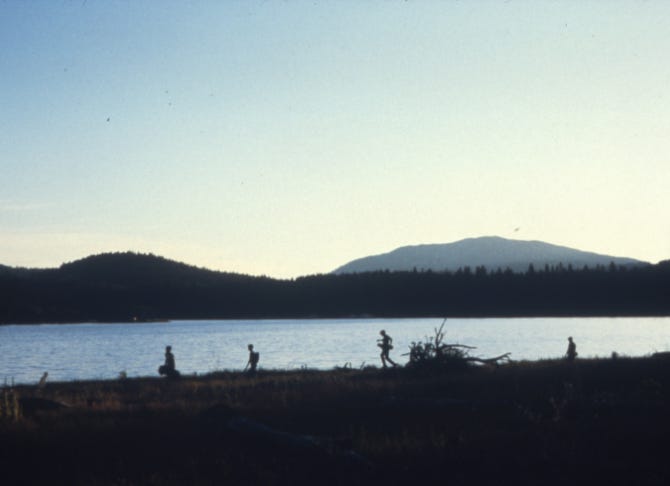
In the late summer of 1986, a small film was released about four 12-year-olds who venture into the wilderness to confirm rumors that a dead body has been found just outside their hometown. The event changes their lives forever.
For those of us who saw the film growing up, it instantly elicits an emotional response. When it appears, as another title on this or that streaming platform, we may hit play and find ourselves, invariably, wiping away a few embarrassed tears. This is not merely our aging cohort giving into cheap nostalgia. It is a creeping realization that the film’s depiction of bonding and loss cuts deeper with each passing year.
The film is, of course, Stand by Me.
When the movie opened in theaters nationwide right before Labor Day, Madonna’s “Papa Don’t Preach” was the #1 song on the radio. The now-forgotten detective show Riptide aired its very last episode on NBC. Top Gun, the testosterone-fueled phenomenon starring Tom Cruise, had come out a few months earlier. Hollywood and TV were in peak blockbuster mode. Cable and VCRs were transforming how and when people consumed entertainment. In just over a year, Tom Wolfe’s bestseller Bonfire of the Vanities, an epic of greed and glut, would be published to controversy and acclaim. Money was valued above all else—not merely as currency but as something akin to a second birth certificate for those who had it: with enough cash, you could buy your way into a new identity—one more befitting of those gilded years. Everything needed to be big, bold, sexy, and fast. Everybody clamored for more and more. And more.
In this frenzied pop culture environment, Stand by Me arrived as a throwback misfit; the kid in the corner of the classroom who actually read the assigned books while also trying to hold their own (and failing) at various blacktop sports. Kids like me.
Directed by Rob Reiner and based on Stephen King’s novella The Body (1982), the film tells a sensitive yet uncompromising R-rated coming-of-age story set in late 1950s Oregon. The 39-year-old Reiner, son of famed comedian Carl Reiner and recognized primarily as a comedy talent from All in the Family and This Is Spinal Tap (1984), did not yet have a track record as a proven director, let alone one known for tackling challenging material. Only days before filming was set to begin, Embassy Pictures—the movie’s financial backer and distributor—was sold to Columbia Pictures, a company which made clear that it planned to cancel production. Norman Lear, the legendary creator of All in the Family, personally invested $7.5 million to help complete the film based on his belief in the untested Rob Reiner and the script. However, the small movie no longer had a distributor following the sale of Embassy. As the story goes, after Paramount, Universal Pictures, and Warner Bros. all declined to serve as distributors, Columbia Pictures’ production head Guy McElwaine screened the film at his house with his daughters in attendance. Their enthusiastic review convinced McElwaine to distribute the film. Despite the risks and challenges attending the project, which was almost shelved from the start, Stand by Me finally began shooting in the summer of 1985.1,2
Made for a modest $8 million, the movie would play in theaters for the rest of 1986, earning an impressive $47 million (or over $136 million in today’s dollars). Many critics lauded Stand by Me upon its release, with Sheila Benson of the Los Angeles Times describing the movie as “the summer’s great gift, a compassionate, perfectly performed look at the real heart of youth. It stands, sweet and strong, ribald, outrageous and funny, like its heroes themselves—a bit gamy around the edges, perhaps, but pure and fine clear through. It’s one of those treasures absolutely not to be missed.” It was also nominated for a Best Adapted Screenplay Oscar at the 1987 Academy Awards.3,4,5
The little film in a loud era became a hit. The risk paid off.
More importantly, though, the film became a multigenerational classic. Few movies speak as intimately to the rupture that happens when being ‘just a kid’ slips into sober adulthood. Stephen King recently wrote that, when Reiner first screened the film for him, he felt so emotionally overwhelmed that he “went into the nearest men’s bathroom and sat in a stall until I got myself under control. [. . .] When I came back from the men’s, Rob and I had a more normal conversation. He asked me for notes; I had none. I had just let the whole thing wash over me. I marveled at what a good story the truth could make in the right hands.” That’s high praise from King, the renowned writer and author of the source novella, which echoes ‘the past washing over’ feeling that affects many viewers.6
Indeed, the film is an unpretentious masterpiece, not so much concerned with lost innocence as with the secret reserve of strength we draw on to revive what we loved so unconditionally as children. This is the conjured inventory of everyday tokens, triggers and fragments we stubbornly keep from being deemed unremarkable and cliché…Cherry Pez. Backpack comic books. Pizza by the slice. Open hours. Closed adults. Summer night. Winter’s breath. Friends whose faces we can’t quite remember anymore. Tinny music. Movies.
…And movies most of all. When that giant screen lit up against an afternoon darkness, with the scattered crunching of popcorn filling the space between dialogue, it was a brand new reality, at least, for a few hours. Whether you sat in the multiplex anchoring your local mall or curled up in front of your modest ‘home theater’, the movies existed outside of, yet imprinting, the moments that passed. For those of us who fell in love with cinema at too young an age, our memories often seem indistinguishable from all those flashing-moving-singing images and sounds. This is probably not healthy—a thrilling, expressly American co-dependence between self and illusion—but no matter how good or bad the movie selection happened to be, it never let us down as an experience. Most things did. Most things changed out of decline or, more likely, because we changed, because we grew older and moved on. The movies, however, didn’t forget. They never do.
When I discovered Stand by Me, I found myself comfortably settling into the film nearly from the first frame. It was familiar but not forced like most rote flicks about pubescent angst and awkwardness. It also didn’t hide the world’s petty abuses that I intuitively knew clawed just below the surface. So, with my reflected visage hovering as an acned apparition in the corner of the television screen, I trekked alongside those 12-year-old boys as they struck out into the unknown wearing ratty t-shirts and bedrolls slung over their shoulders. All of them either resembled friends I had or revealed vulnerabilities I silently marked in myself. The film felt close. It served as a kind of cinematic shoebox filled with talismanic errata I had collected as a kid and kept securely in the invisible safe under my bed. I knew it would be there, always.
Stand by Me also helped steer me toward an obsession with film more broadly. While my father would show me everything from Captain Blood (1935) to The Godfather (1972) when I was still quite young, films that stirred the brain and heart in their own ways, Stand by Me seemed to play exclusively for my eyes. Getting to know those four boys testing their mettle by confronting the perils of junkyard dogs and swamp leeches, not to mention their own mortality, made it easier to explore the world on the other side of every film encountered afterwards. There is a definite, reeling thread in my mind that connects Stand by Me to The 400 Blows (1959) to 8 ½ (1963) and so on. Reiner’s funny, somber tale of childhood’s end ultimately served as a passage and promise all at once. It was part of a naive but protective prayer captured in the sacred Ben E. King pop ballad from which the film gets its title:
When the night
Has come
And the land is dark
And the moon
Is the only
Light we’ll see
No I won’t
Be afraid
No I won’t
Be afraid
Just as long
As you stand
Stand by me
Perhaps as a form of subconscious observance and penance, I still, soda pop in hand, revisit the movie every few years without fail.
And, at the risk of sounding like a heartsick old fool, I hope people, especially young people, will continue to see Stand by Me and other ‘small films’ like it—and appreciate what they inspire. Such works offer an antidote to today’s data-driven mandates and studio decision-makers who wrongly view legacy IP and anodyne blockbusters as the only way to keep the Hollywood system (or what’s left of it) running. If this was the case when Stand by Me was originally released, it’s exponentially more true today.
When films like Stand by Me get the recognition they deserve, it helps reinforce why we still make movies in an otherwise wearied and saturated media culture: to tell original stories that reflect, connect and reimagine who we are. They are the stories that arrive when you’re young, then return throughout your life. They are not transitory. They become part of you.
These types of films actually resonate and last, offering a durable source of solace (as that shoebox under the bed). This is especially true when, as one character in Stand by Me says, “It happens sometimes. Friends come in and out of your life, like busboys in a restaurant.”
The films make the inevitable pain and loss you encounter in life a bit more tolerable.
***
Toward the end of Stand by Me, the four 12-year-olds finally come face-to-face with the dead body they set out to find. It’s the corpse of a fellow young boy decomposing in a bush by train tracks that lead back to their hometown. His eyes gaze past them, stupid and vacant.
It is what it is. Nothing more, nothing less. All the aphorisms apply, but don’t.
Eventually, the boys cover the body with a gray tarp before heading back home. The film’s narrator, voiced by a wistful yet resigned Richard Dreyfuss, proceeds to recount what happened over the years that followed for the four boys, now irrevocably altered by the journey.
One of them stayed behind in town and had a few kids. One ended up in jail, then drifted from job to job. One, Dreyfuss’s character as a boy in the story, became a writer, like most hapless observers. One, the de facto leader of the pack, got out of town against all odds to become a lawyer. While at a random fast food joint, two men ahead of him in line started a fight. He tried to help diffuse it. They pulled a knife. He was stabbed in the throat. He died almost instantly.
Life took them all down both expected and unexpected paths, but it took them, nonetheless.
When the film draws to a close, the titular song begins to play. It croons while the credits appear and fade from the screen.
***
After the success of Stand by Me, Rob Reiner would go on to direct and produce a series of well-regarded and iconic films across genres, including The Princess Bride (1987), When Harry Met Sally (1989), Misery (1990), A Few Good Men (1992), and The American President (1995). He also became an outspoken activist and, over the course of his multi-hypehnate career, something of an unofficial statesman for Hollywood.
Then, like for his characters, there comes an event to change things.
On Saturday, December 13, 2025, Rob Reiner and his wife attended a Christmas Party with friends and family. At some point after the event, they were both assaulted and murdered in their Brentwood home. Their daughter discovered the bodies on Sunday morning. The Medical Examiner confirmed evidence of “multiple sharp force injuries.” They both had been stabbed to death. Their adult son was arrested and charged with the crime. Sources say he has had a history of mental illness and drug abuse. The case remains open at the time of this writing.7
The reasons for the murders remain unknown. Even if we ever know, we won’t.
Hollywood responded with shock. In a statement to The Hollywood Reporter, Sean Astin, the president of SAG-AFTRA, said, “Rob Reiner is one of the most significant figures in the history of film and television. The impact he made on American culture simply can’t be overstated.”8
Wil Wheaton, who plays the narrator’s character as a boy in Stand by Me, wrote, “When I was turning 13, and realizing that my own father didn’t care about me, that my mother didn’t see me as a son, but as a thing she could put to work, Rob Reiner made me feel loved, valued, seen, and respected. He made sure I knew that I was important to him and his movie.”8
Rob Reiner was 78 years old when he died. His career in film and TV spanned seven decades. He made movies for people who live for and through the movies—people who unashamedly cry and fight for what’s up there on the screen. It’s personal. It’s us. As Reiner once said, “If you have tapped into something that is real for you, chances are you are going to tap into something that is real for someone else.”9
This is not an easy thing to do. It’s just the only thing to do if you want to produce anything worth a damn.
About two-thirds of the way through Stand by Me, the young boys share an emotional moment when one of them, a gifted storyteller, begins to doubt whether to follow his creative dreams. His friend tells him straight: “It’s like God gave you something, man, all those stories you can make up. And He said, ‘This is what we got for ya, kid. Try not to lose it.’”
Rob Reiner heeded that call, investing the requisite heart and chutzpah to reach others. He tried and succeeded.
***
When I first learned of the murders, and before the tributes started to pour in, the news pinged dumbly on my phone like so many other calloused headlines about Hollywood and the greater fragmented world we inhabit. Just another outrage, another tragedy to swipe through. I reflexively grew angry and exasperated, unable to process the event’s significance. I felt closed.
Gradually, though, the realization of what had happened began to register as a deepening dread and sadness. The feelings became all the more acute when I considered the upheavals in 2025 that have impacted the film industry. Catastrophic L.A. fires. Collapsing box office returns. Mass exodus of production and development jobs leaving California. Looming studio mergers and consolidation. Potential disruptions caused by AI technology. Theaters facing lower revenues and possible obsolescence. And, the additional deaths of giants and trendsetters like David Lynch, Robert Redford, Val Kilmer, Diane Keaton, and Gene Hackman….now the Reiner murders.
The industry and culture are undergoing seismic change. The dream factory we knew is going away. What comes next will be much different.
I am doing my best to handle this truth. It is not easy. Film and filmmaking will endure, but not without us stewarding it forward by holding to where we came from and who set the stage for making it happen. I find myself revisiting what the mixed glitz and art meant in the first place, what the unseen lights and cameras gave us—what they gave me—over all these years.
That’s when I remember sitting in those theaters or at home in front of the television. My undivided attention followed every beat of the unfolding story. Made-up worlds and movie stars appeared as paradoxically apart and a part of me. Somehow, the entire experience coalesced as the only real suspension of disbelief I ever knew, then or since. And, when the lights came on and the credits rolled, I studied the names of the crazed ones who made it real—at least, for a little while.
When I think of Stand by Me, I think of watching and rewatching the movie, how such a small film affected me so much. It’s always there. I think of seeing those kids on screen in the deadly adventure of their changing lives, and, in that brief instance, being seen myself. I think of where they’ll lead me next. I’m ready to be unafraid.
No, we may never have the friends and moments like the ones we had when we were 12, but we have the movies. Jesus, isn’t that worth something?
Sources
“‘Stand by Me’ Oral History: Rob Reiner and Cast on River Phoenix and How Coming-of-Age Classic Almost Didn’t Happen.” Variety, 28 July 2016, www.variety.com/2016/film/news/stand-by-me-30th-anniversary-oral-history-corey-feldman-1201824490/.
“How ‘Stand by Me’ Was Almost Left Standing at the Gate.” Chicago Tribune, 21 Nov. 1986, www.chicagotribune.com/1986/11/21/how-stand-by-me-was-almost-left-standing-at-the-gate/.
“Stand by Me.” IMDb Pro, pro.imdb.com/title/tt0092005/details.
Benson, Sheila. “Movie Review: ‘Stand by Me.’” Los Angeles Times, 20 Aug. 2016, www.latimes.com/entertainment/movies/la-et-mn-stand-by-me-review-20160820-snap-story.html.
“The 59th Academy Awards | 1987.” Oscars.org, www.oscars.org/oscars/ceremonies/1987.
King, Stephen. “What Rob Reiner Saw in Me.” The New York Times, 16 Dec. 2025, www.nytimes.com/2025/12/16/opinion/culture/stephen-king-rob-reiner-stand-by-me.html.
“Rob and Michele Reiner’s Cause of Death Released by Medical Examiner.” The Guardian, 18 Dec. 2025, www.theguardian.com/film/2025/dec/18/rob-and-michele-reiner-cause-of-death-determined-by-medical-examiner.
“Rob Reiner Dead at 78: Hollywood Reacts.” The Hollywood Reporter, 15 Dec. 2025, www.hollywoodreporter.com/news/general-news/rob-reiner-michele-singer-dead-reaction-1236450442/.
BUILD. “#AOLBUILD Hosts Director Extraordinaire Rob Reiner.” HuffPost, 17 July 2014, www.huffpost.com/entry/aolbuild-hosts-director-e_b_5595183.
— Note on Imagery: Unless I’ve provided credits for images in these posts, please assume they are produced by GenAI tools. I am not a designer or visual artist. An admirer, only. But I do enjoy concocting crazy-ass but relevant prompts, then reviewing and tweaking what the mighty engine delivers. With this said, I love to showcase the doings of flesh and blood artists. Send me a suggested work if you believe a particular artist’s contributions would be better suited to replace one of the generated images. These entries can certainly evolve. I will consider your request. Many thanks.
This is the end. Want more?