


Mea Culpa. I will start with the obvious: this post is waaaay overdue. Unfortunately, due to other personal and work obligations, I needed to step away for a few months. Such is life. Don’t hate me. But On and On and On goes…on. I’ve picked up where I left off in this thorough deep dive series on the state of the film and TV ecosystem. Benefits of taking so damn long on this front:
I’ve also gone back to update some stale figures in Parts 1 and 2a of this series to make everything all the more relevant and timely.
In some ways, I’m glad I halted my writings, as major industry shifts that appeared to be on the horizon when I initiated this series last year have started to materialize in reality. Namely, the industry mergers and shifts I planned to discuss in upcoming Parts 3 and 4 are now underway in reality, not just looming as mere projections or theories (e.g., Paramount vies to acquire Warner Bros, new film trends now look to upend previous notions of what’s bankable versus not, etc.). It is a topsy turvy time, and particularly ripe for taking a step back to understand where the hell we actually stand at the party.
Fair warning: this entry runs a titch long. There was simply too much ground to cover on how providers compete for global audiences right now, and I'd rather give it room than shortchange anything of note. Good news for the time-pressed (i.e., all of us) is that Parts 3 and 4 return to a tighter format.
Stick with me.
Yours late but not fully lost,
OnOnOn
Let’s pick up where we left off in Part 2a.
Recap: you’re an everyday media consumer. According to global averages, you spend around 12 hours per week on streaming, TV and going to the movies, which competes for your attention alongside social media, long-form video, podcasts, music, reading, video games, sleep, and general anxiety about the future. Right…uh…[brain blended, senses saturated]…check.
The stream never ends. The whelm of content results in bewilderment that exacerbates into choice paralysis before deteriorating into apathy. “I guess I’ll just watch an old episode of Friends again.”
The deluge at breakneck speed is exhausting. It begs for a reset, a path to simplify optionality without limiting creative and cultural diversity.
Part 2a detailed both how audiences found themselves drowning in media and where there appear to be glimmers of hope going forward. This entry—numbered 2b, because I had to cut the original in two (forgive me)—concentrates on how film and TV providers have shifted efforts to substantively understand, serve and engage their most loyal audiences, wherever in the world those customers happen to be.
Steady your cup of chaiofftea (what’s that? Again, read Part 2a). Take a sip. Inhale. Exhale. Read on.
The Great Reckoning

Film, TV and social media content comes at us in constant, numbing abundance. Let’s be honest, though: the tsunami isn’t new. It’s part of an ongoing development. The curve has been bending for the past 25 to 30 years. The former media institutions—broadcast, cable and movie theaters—lost their power and primacy as a driver of monoculture to new, disruptive hordes of streaming and social media invading with abandon. Fragmentation and cacophony ensued. Industry analyst Alan Wolk compares this to the fall of Rome and a transition to what he aptly calls ‘feudal media’.1
In retrospect, we can see the inevitability we’ve been steering into, like that T-Rex in Jurassic Park (1993) gnashing in the rearview mirror while we try to speed away from the tech-driven immersion a few billionaires established for ‘bringing wonder to the world’. That famed line from Park could be applied to the hypermediated entertainment ecosystem we now inhabit: we were so preoccupied with whether we could, we didn’t stop to think whether we should.
And it happened pretty quickly. Back in the early aughts, we were stuck in the glut of 200-channel cable subscriptions, which became exorbitant bundles unable to keep up with demand and addled by advertising. Streaming services snuck in, multiplied like jackrabbits on Cialis to dominate TVs and phones with infinite choice. YouTube and the social platforms gave rise to creators and influencers, a seemingly proximate and endearing cabal of homegrown gossips and tastemakers. Theaters, once the epicenter of film culture, entered decline as reeling projectors were pitted against hi-def screens available everywhere, including the smartphones nesting in your pockets.
Technology—digital, portable, omnipresent—wowed, wired and wearied us. Quick access beat out deep experience. Clicks trumped critical thinking.
Basically, we’ve found ourselves strung out.
The mid-2020s may be remembered as when someone at the party kicks open the door to let the sunlight in. Everybody realizes they have been corralled in self-made caves for years, vampires converted by (and addictively cavorting with) other vampires. The endless content, enthralling at first, gave way to indulgence and excess.
Exhausted and shambling between apps, audiences seek less confusion and fewer distractions (while saving hard-earned cash in the process). It’s not so much a yearning for a nostalgic leap back to the 20th century as it is a desire for intentional focus without compromising the boundless discovery originally promised by all things online.
A simple, stupid moment of clarity splashes cold water in your face: it’s exhilarating to be on a ship in the middle of the open ocean, but without a compass and a purpose, you’re simply adrift.
Entertainment providers are taking notice, too. They see subscriber numbers plateau, churn rates erode revenue, box office numbers decline, and cable wither away. Scary adult concepts like ‘profitability’, ‘consistency’ and ‘quality’ are rearing their heads in boardrooms of entertainment providers. Rehashed content and algorithmic junk food are losing their ability to lock in the masses. Viewers want better. In response, and out of necessity, the industry has evolved from ‘get as many eyeballs as possible’ to ‘secure the fans who care most.’
There are also clear leaders and laggers in the space. This becomes painfully evident in the financials.
In Q1 2026, Netflix posted $3.96 billion in operating income from streaming — more than every legacy competitor’s streaming business combined, and it isn’t close. The cleanest head-to-head is Disney, the only other major media company that reports streaming on the same operating-income basis: Disney’s Disney+/Hulu unit earned $582 million for the quarter.2 Netflix out-earned it nearly seven to one from a pure streaming business, with no theme parks, studios, or cable bundle propping up the number.
The rest of the field reports streaming as adjusted EBITDA, which is a more forgiving measure that sits above content amortization (a cost that helps define streaming economics). On that looser basis, Paramount’s direct-to-consumer unit swung to a $251 million profit and Warner Bros. Discovery’s streaming segment cleared $438 million, while Comcast’s Peacock remained the conspicuous loss-maker at a $432 million deficit; though Comcast’s CFO does expect Peacock to approach profitability in Q2.3
Still, Netflix is navigating choppier waters as well. As of this writing, the platform is showing signs of audience engagement decline and a stock price down roughly 40 percent from its June 2025 all-time high; its share of U.S. TV viewing fell to 7.8% in April 2026, its lowest mark since May 2025. The Big Red N remains the leading premium streaming platform but faces increasing competition from YouTube and social media insurgents like TikTok and Instagram.4
Antenna’s Q1’26 read on the year for streamers is even blunter: premium SVOD subscriber growth fell into single digits in 2025 for the first time, and weighted-average churn stabilized around 4.6%.5
It also means that the first era of the so-called streaming wars didn’t end in a tie or ‘healthy and competitive marketplace’. They concluded with a few clear (but ever hustling) winners, two or three competent operators, and a crowded long tail of platforms trying to figure out how to matter. Audiences, as a consequence, have been left in a daze, drunk on the deluge and not remembering everything they watched. It’s too much.
That old dinosaur of common sense caught up to us. Attention has been split, diced and drained. Entertainment providers of all stripes must define clear value or face obsolescence.
The inevitable reckoning is here.
From Content Overload to Audience Attunement
Given the current morass, studios and streamers are rethinking their strategic playbook. Wait…what do people REALLY want and need?
Prior to around 2023, companies followed a pretty simple mandate: produce oodles of content based on what historical viewership data indicated would perform well, then relentlessly disseminate algorithmically driven offerings across as many markets as possible. It kept people hooked on a constant content fix.
But audiences have become more selective and cost-conscious. They want variety, but organized, curated and resonant. That’s an extraordinarily high bar, one few providers actually clear regardless of whether they can afford to pursue it.
Netflix and YouTube have claimed the streaming crown so far, because they scaled faster and more efficiently than anyone else. They delivered audiences what they desired in the most immediately accessible way possible, not what a studio hierarchy said audiences wanted.
For entertainment giants of yore scrambling for new ways to compete in this new paradigm, consolidation is inevitable and underway in some cases (more on that in the next entry). But it is also an occasion to refine value propositions around the what and how of greenlighting and distributing content—and, yes, how to do that at scale. Legacy studios cannot magically expand their market share to the glory days of old; they need to earn it again.
What matters more than anything…wait for it…is the content. Duh, right? But this is often misunderstood. It’s not just about chasing massive opening weekends or a streaming launch that ignites millions of televisions. The key for studios and streamers is to release durable and diverse IP with a long shelf life. This spans theatrical release, PVOD, SVOD, AVOD, FAST, CTV, and traditional cable, as well as real-life (IRL) experiences that collectively generate net-gain revenue.
First, we just have to be honest that, over the first quarter of the 21st century, intellectual property became less about intellectual exploration and more about property expansion. Still remembering that first high they felt when Jaws (1975) and Star Wars (1977), studios kicked off the blockbuster age, spent decades chasing avenues to keep the good times rolling in a newly globalized marketplace. With the help of wizards, aliens, anthropomorphized-everything, and surfeits of superheroes, a handful of franchises evolved into cash machines, spawning endless derivatives that bought up the real estate of 4-quadrant filmgoer imagination. Bigger budgets could always be justified because the grosses were astronomical. How do you keep it going? More sequels. More spinoffs. More spectacle. More. More. More.
Some of these franchises delivered great movies along the way, but that was almost beside the point. Even entries with middling reviews yielded so much mindfucking money that quality became optional. By 2019, the machine had hit overdrive and the first high had curdled into a numbing addiction: bigger profits demanded sequels, which inflated audience expectations, which required bigger budgets. Ouroboros patterns, anyone? Studio executives forgot that the people who christened these phenomena were often crazy artists with bizarre visions who had somehow snuck into the puckered kingdom of suits and accountants. Instead of stewarding new generations of nascent Spielbergs, the ruling powers channeled available talent and resources into replicating proven formulas. Result? Assembly lines of creatively constrained artists produced a cheap thrill parade of crowd-pleasers, with only scant opportunities to smuggle in original ideas.
Then Covid-19 hit. Theater attendance, already in decline despite the comicbookification of moviegoing (a trajectory traced in Part 1 of this series), went off a cliff. Globalization proved more complicated than anticipated, too: China and its massive audiences no longer boosted box office figures amid economic and political tension with the U.S. And, more broadly, he general public recognized they were always on some version of the same roller coaster track. YouTube, Netflix and staying home became the more alluring proposition. As the box office dissipation of 2021 rolled into 2022, 2023 and 2024, studio execs and their bean counters started to panic, point fingers and plot escapes. Why didn’t you get into streaming faster? How in the hell can we expect to keep spending $250M on every film?. The money machine had been revealed for what it always actually was: not an unbeatable movie widget generator™, but a star-spangled casino that would implode once the audience realized the creative concessions weren’t worth the cost.
The faucet of big-budget Hollywood IP has not gone dry as a consequence—you can still catch an ample share of sequels and spinoffs at the nearby multiplex—but the gushing torrent has become, well, more of a stream (sorry).
Increasingly, studios are reevaluating content/new IP as a long-term investment, measured over time, window to window. Mass audience appeal is slowly transitioning to targeting specific niche demographics, which relies on budget allocation relative to probable outcomes over the content lifespan.
Studios, in short, are learning from the Netflix and YouTube models while figuring out how to both operate in ways unique to the big reds and leverage their own unique strengths (i.e., creative development expertise honed over decades and more extensive content libraries).
This is a meaningful break with previous high-pressure theatrical release and streaming-wars logic. ‘Get immediate returns as fast as possible’ is evolving into ‘produce and present IP as an evergreen proposition.’ Such a mindset explains the licensing posture across the industry. In the early days of streaming, studios were willing to license content to Netflix as a kind of extended marketing tactic (i.e., ‘leverage the growing streaming platform to increase exposure and audiences will come back to our channels’). This did not always happen, though. Viewers often just stayed on Netflix. There are now-famous, or infamous, examples of how programming performed much better once licensed out: Mad Men and Breaking Bad recorded modest ratings on AMC, and Suits on USA Network, before all three became major hits after being featured on Netflix.6 Note, however, that the inverse of this arrangement is not typically true. Try finding Netflix’s branded and owned originals, like Stranger Things or Squid Game, licensed and available outside the platform…not so much. It speaks to who holds sway…for now.
Of course, licensing will remain in place for all involved. Netflix, too, will likely license out more content at some point. The revenue and built-in marketing exposure benefits are simply too great to ignore. But industry players, especially the studios, are more cautious about how and when it makes sense to activate their content across competitor platforms. As analyst Robert Fishman put it, “Perhaps it’s time for studios to return to the chessboard and recognize that feeding the beast with licensed content may bolster near-term earnings—but ultimately erodes the value of their proprietary IP and streaming services.”7
The mandate seems clear: think long-term gains by 1) steadily diversifying IP across budget ranges with old AND new content (spandex gives way to creative elasticity), then 2) fiercely protect the gems that make you distinct as a provider while 3) leveraging what’s languishing in the vaults as a licensing lure to bring in supplemental revenue and reel in viewers from other platforms.
Rather than entertainment and media behemoths resting on their laurels and pumping out more of the same ad nauseam, the emerging era demands a reappraisal of multiwindow economics and resuscitated imaginations to try new things…or suffer the fate of the stagnant, swept aside with a swipe on a phone or quick toggle to the first app one sees on their TV.
Scaling with Quality Is Essential — But Not Easy
So, how do providers strive to maintain audiences in an era when content preferences continue to shift in a crowded ecosystem? Whether Paramount or Netflix, they seek to cultivate the most devoted and invested fans possible for generating sustainable revenue—and to do so at scale. It’s a game of depth and breadth. Studios and streamers consequently must act with global ambitions to remain relevant and keep up with growth goals, particularly as consumer attention is pulled in multiple directions and the platform marketplace in the U.S. remains saturated. At the same time, target audiences are also becoming highly selective and rediscovering an appetite for cost-friendly viewing experiences.
Ergo, it is pretty goddamn daunting for big media companies to remain competitive. They must be prolific, fast, innovative, and (increasingly) global—while retaining audiences in the process, which is the most difficult task at hand.
Steadily and surely, particularly in the West, providers are hitting price tipping points on their offerings. Consumer appreciation for subscription value diminishes in proportion to the volume at which they yell obscenities while scanning monthly bank statements. Disposable income cannot keep up with the sprawling bazaar of options. The result is subscription fatigue and churn.
In response, streaming providers seek the most lucrative price point per international market to maximize average revenue per user (ARPU). But it’s a careful dance. ARPUs in developing markets are often a small fraction of U.S. and European levels, yet these markets, with suitable connectivity and growing middle classes, offer real opportunity.8
Some providers and platforms expand abroad more effectively than others, particularly when it comes to managing subscription costs across different countries. The most expensive Netflix plan in the U.S. is now $26.99 (before taxes) for ad-free Premium 4K + HDR; the cheapest ad-supported tier is $8.99.9 That cost spread roughly triples from base to premium. Disney’s narrower differential between its most ($18.99) and least expensive ($12.99) tiers makes each price hike a more precarious game.10 Contrast this with India, where Netflix runs four ad-free tiers billed monthly, from a mobile-only plan at ₹149 to Premium 4K at ₹649 (roughly $7.50, or about a quarter of the U.S. Premium price).11 The combination of low entry point and high top tier helps explain why Netflix has grown its base without sacrificing ARPU during price increases. Robert Fishman argues it’s precisely the strategy the legacy conglomerates should emulate.7 Ad-supported tiers are doing real work here: by the first quarter of 2025, ad-supported plans accounted for 57% of all new gross adds across premium streaming services, up from 42% two years earlier.12
But didn’t we leave commercials behind?…maybe not so much after all.
It also isn’t a matter of having the latest major studio releases ready to disseminate to every viable market. Mass-produced, Hollywoodized prestige doesn’t carry the weight it once did. Cultural exports still have tremendous cachet, but only when production, programming and marketing work in concert with local interests and demand. For every Taylor Swift or K-pop sensation that breaches borders, there are more concentrated vehicles on a market-to-market level, emerging from what would once have been seen as unlikely sources. They spread through word of mouth and online viral exchanges on Instagram, TikTok, Discord, Twitch, and Reddit.
Cultural shifts occur and spread fast. Compare our age, for instance, to the shock of the new à la the kind that nearly produced riots at the first performances of Stravinsky’s Rite of Spring in 1913. Can you imagine people taking to the streets with raised torches over an edgy A24 release or inaugural season of [insert audience bait here]?
Everything is available, if also more transitory, not to mention simultaneously hybrid and derivative to the point of being random without lasting impact. It creates a media and entertainment culture that is diverse but rarely lasting.
Such an environment breeds skeptics of Pollyannaish narratives celebrating purported ‘unprecedented global creative diversity.’ Critics examine how increased access to technology has, counterintuitively, seemed to stall cultural innovation as we once defined it.13 This read can be too simplistic, though. It’s more accurate to say that the new stays new for approximately three seconds. Shock gives way to meme-worthiness, to being ingested and cataloged within days, if not hours.
As one of many examples, anime was a curio in the West only forty years ago. Today, Demon Slayer: Infinity Castle, released in mid-2025, pulled in $781 million at the global box office to become the confirmed highest-grossing anime film of all time.14 Each passing year brings these surprises to disrupt what is viewed as expected audience tastes. It isn’t that myriad cultural phenomena fail to export, as much as they rapidly fade from collective consciousness or come back just as fast in the form of nostalgic recycling. A kind of hyperactive, multicultural content loop is inevitable, with ‘past’ and ‘present’ seeming to collide, conflate and overlap for creators and audiences alike.
What is always ‘new’ and never should be forgotten?: the how, when and where a given individual audience member encounters a cultural product. Yes, algorithms certainly engineer echo chambers in deleterious ways, but the innumerable permutations queuing up in a given consumer’s feed cannot be dismissed as shallow noise. I often call this the formation of the ‘uber-narrative’, or complete record of a given individual’s content intake, where all programming and products feed into a larger cultural experience that is by turns the result of influence and suggestion as well as deviations from patterned consumption habits.
Providers who understand how to weave recommendations together in a way that blends the familiar and the fresh maximize audience retention. This involves paying close attention to data-informed user experience, taste profiles, and release timing; these things matter. Now more than ever.
To further expand and succeed globally, entertainment companies must be culturally attuned to each new international locale without sacrificing operational efficiency. Streaming platforms need to localize content in alignment with social norms and cultural expectations, including translation, adaptation, subtitling, dubbing, and omnichannel digital marketing.
Disclosure: Wordbank, the company I work for as a strategist when not writing for On and On and On, provides marketing localization services to streaming and entertainment companies.
These marketing localization components are too often treated as afterthoughts by providers, souring end users who reasonably expect content delivery tailored to particular regions, countries, provinces, and cities. There are also infrastructural and legal requirements at play: adequate payment systems, regulatory compliance at the jurisdictional level. These are the essential but mundane details no one wants to worry about. Without comprehensive knowledge of local customs, norms and governmental policy, global ambitions requisite to stay competitive can amount to temporary success at best and abject failure at worst.
The savvy international viewer, if feeling dismissed, exploited or culturally ignored, will tune out faster than any incensed aesthete walking out on Stravinsky’s Rite of Spring back in the day. Rest assured.
Engagement, Engagement and (Still More) Engagement
Okay. You’ve successfully launched and distributed your show about an insomniac chef-turned-spy on an intergalactic freighter in 2235 (’He’ll sleep when you’re fed…and dead’). It’s even going overseas based on audience research showing higher-than-usual interest across 12 target markets in space espionage, haute cuisine and REM deprivation.
Now you have to keep these people watching and invested. When there are so many international cultural attractions and distractions available at a range of prices, entertainment companies must keep viewers interested and buying in. Yes, subscriber growth still remains important, but it’s audience time investment that translates into long-term revenue across windows. What the almighty ‘Engagement’ buzzword really means is that platforms are trying to build IP communities one committed audience at a time.
In this state of affairs, content becomes not just an entertainment escape but a constant homebase for viewers. Hours spent across formats and mediums (e.g., movies, TV shows, video games, theme park attractions) translate into deep loyalty and compounding earnings. Time matters more than clicks. This is the era of loves over likes. Evan Shapiro calls this the attention economy maturing into the affinity economy.15
Some companies and providers do this better than others. For sure.
Netflix confirmed paid memberships exceeding 325 million globally as of Q1 2026; an audience the company itself describes as ‘approaching one billion people globally’ when accounting for shared households. In the second half of 2025 alone, Netflix users watched a collective 96 billion hours on the service, with viewership of originals up 9% year over year. The hits speak for themselves: Stranger Things 5 accumulated 1.39 billion hours viewed; Wednesday Season 2 drew 928 million hours; Adolescence (2025)—a four-episode limited series—amassed 546 million hours and 142 million views to become the second most-watched English-language series in Netflix history.16
And then there’s YouTube. In the U.S., YouTube has been the #1 source of content on TV every month since April 2025, with at least one billion hours watched on televisions daily.15 In July 2025, YouTube captured 13.4% of all U.S. TV watch-time — widening its lead over second-place Disney to four full share points, the largest lead any media company has established since Nielsen began tracking distributor rankings in November 2023.17 To put that in concrete terms: YouTube’s share outpaced combined viewing across the broadcast networks, cable channels and streaming platforms of Disney (9.4%), NBCUniversal (7.6%), Paramount (7%), Fox (6.5%), and Warner Bros. Discovery (6%). By February 2026, YouTube held 12.5% of total U.S. TV viewing, nearly double its 7.9% share from two years prior.18 And that’s without YouTube TV, mobile, desktop or Shorts factored in.15
The market has simply changed. The party isn’t just a cage match pitting Netflix, Disney+, and HBO Max against each other. It’s all of them competing against a mini-universe in YouTube, which has quietly become the largest content offering by treating its creators as an inexhaustible talent pool and its viewers as a close-knit community.
Pressing the point on the affinity economy concept, Evan Shapiro and his team recently released a “first-of-its-kind index of consumer time and attention across all screens”, which documents time spent on major US media platforms over the period of December 2025–May 2026 across TVs, phones, and personal computers. Distilling aggregated data from Nielsen, Comscore, GWI, and FCC, Shapiro’s breakdown is revealing and, unsurprisingly, largely corresponds with the previously cited financials for all the media titans.19
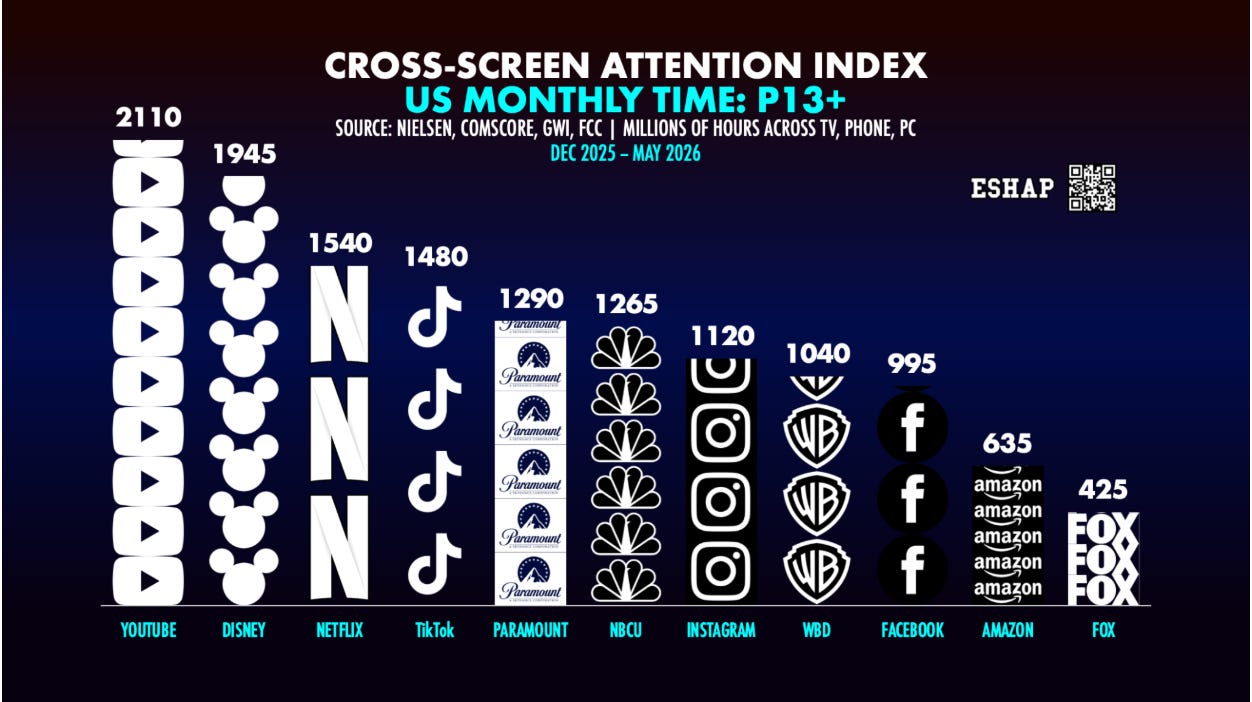
YouTube, of course, stands imposingly as the great vacuum of curiosity with over 2 billion hours of monthly viewing for audiences aged 13 years or older. Disney is the only traditional media company in the top 4 given the company’s vast, enduring IP library appealing to nearly every age demographic and distributed across multiple channels. Still, Walt’s castle is not the insuperable monoculture machine it once was, even just two decades ago.
But it’s the Netflix numbers relative to other media providers that warrant pause. While Netflix’s rise is impressive—the platform’s ascendancy defines our streaming era in many ways—the importance of YouTube’s dominance as well as the meteoric climb of TikTok and Instagram cannot be overstated: user-generated and vertical short-form content upended not just the media industry as a whole, but altered what people expect to watch and consume on a daily basis.
For a healthy film and TV ecosystem to evolve, it is imperative to respect and absorb this new reality. Cinematic art and TV programming of old still have their prominent place in our culture (more on that in a future entry), yet not without operating in a symbiotic relationship with all things populating YouTube reels and unspooling on your phone/auxiliary appendage.
The legacy players are beginning to take note…haltingly, sometimes belatedly, but unmistakably. Disney+ and Peacock have indicated that their push into vertical video and creator content could extend well beyond reclippings of existing shows. At the 2026 Upfronts, NBC quietly signaled connection to the creator ecosystem (e.g., using creators during Olympic coverage), Disney let Dancing with the Stars winner (and TikTok star) Robert Irwin announce a DWTS spinoff he’ll host, and observers noted the event for signaling a broader industry shift. Fox’s Tubi, meanwhile, has built a business out of giving YouTube talent deals for shows and movies as part of its so-called ‘Creatorverse’ content available on the platform. As one advertiser on the buy-side told The Hollywood Reporter when surveying how creator content has flooded onto every major platform: “What lived outside of the mainstream now is the mainstream. The TikTok-ification of TV.”20
Want that sci-fi show about an insomniac chef-turned-spy keeping eyeballs glued to screens around the world? Make sure it’s not only on every platform, but also extends its universe to clips on Instagram and TikTok. Did it get partially inspired or sourced from a short story on Reddit? Lovely…
…No, this is not relevant to every piece of programming on a platform or coming to a theater near you…but it doesn’t hurt for those greenlighting projects to remain open and curious about such prospects, either.
Netflix as Microcosm

Netflix is also doing what it can to stay in front of the affinity shift. In 2025 and early 2026, the company struck partnerships with Spotify/The Ringer, iHeartMedia and Barstool Sports to bring video podcasts to the platform, and expanded its creator programming with Ms. Rachel and Mark Rober’s CrunchLabs, the latter drawing 12 million global views in H2 2025.21
This reads as a necessary evolution for the leading streamer, particularly in light of recent reporting from Bloomberg’s Lucas Shaw documenting the company’s struggle to sustain audience growth at the same rate as seen in previous years. Customers watch Netflix only 2% more than they did in 2025. The platform also appears to have an issue keeping audiences invested on a season-by-season basis. Massive successes like Stranger Things and Squid Game are the exception, not the rule. Shaw elaborates on the stats: “Season two of Beef suffered a drop of more than 70%. The Night Agent shed 50% of its audience for the second season and another 35% for its third season. These figures are all through the first four weeks of a show’s release and come straight from Netflix.”22
This pattern contrasts typical trends in previous broadcast TV program history, where hit shows peaked in later seasons due to growing popularity and buzz cultivated over time. Think about how everything from Seinfeld to Succession became TV phenomena after initial launch.
Part of the reason for this is due to Netflix’s state as a kind of microcosm of the greater crowded ecosystem. The platform is not dependent on a mere handful of programmatic choices succeeding in any given season or year. The business model operates on subscribers and engagement time. Hits must proliferate to attract and keep eyeballs. Period. Product must be released in a perpetual torrent, with all shows (along with licensed content, live events, specials, and games) vying for limited attention bandwidth from one week to the next. Optimal quality becomes about platform experience and reach, while the branded content output itself is engineered to serve up what Netflix executives have called “gourmet cheeseburgers”, or shows that are, in Chief Content Officer Bela Bajaria’s words, “premium and commercial at the same time.”23 This means fewer of the arthouse or ambitious (and financially risky) undertakings like Roma (2018), The Irishman (2019) and The Queen’s Gambit (2020) of an earlier Netflix era, and more of popular reality shows like Love is Blind and thrillers such as The Rip (2026), Apex (2026) and I Will Find You (2026) presented as selections on a subscriber’s menu alongside 90s studio hits and complete seasons of classic TV shows. Netflix is abundance contained: one platform, continually reshuffling, built to offer something to everyone, all the time—and catering to your endless stay. Microcosm indeed.
At the moment, it is a company being tested by the competitive ecosystem it helped initially bring together and advance. And, regardless of some audience growth rate slow-down relative to entertainment alternatives such as YouTube and Tubi in the last few years, Netflix remains a dominant industry force that has proven itself to be the most technologically sophisticated and internationally savvy of streaming platforms to date. While some media conglomerates were still ignoring the downward spiral of cable and mounting threats to physical media sales, Netflix advanced full speed into streaming. When other providers were still getting their bearings in the streaming era, Netflix not only expanded access rapidly overseas, but also opened major production hubs across the world. This was a genius chess move for sure. It is a company that saw the future film and TV world coming around the corner.
Now, it is time for another dynamic shift. Tech-first players, led by Netflix alongside fellow power brokers like Amazon (Prime Video and MGM) and Apple, must adapt to a world where YouTube, TikTok and Instagram battle for consistent viewership. Legacy media and studios—Fox, NBCUniversal, Skydance (Paramount and, possibly, Warner Bros), and Disney—caught partly unawares by the transition to digital-first entertainment, find themselves behind if also hungry to reassert their financial strength and cultural influence by leveraging their decades of experience making movies and TV.
Yes, consolidation via mergers, acquisitions and divestment (again, the subject of the next entry) plays a role here. Advertising, of course, will continue its comeback in the industry as a way to boost revenues and reduce consumer subscription costs. Yes, all the platforms and providers will take notes from YouTube and vertical format playbooks to garner more attention and, ultimately, affinity.
But the story will be more complicated and nuanced than simply a situation where a few major players are left standing to reanimate a CTV and mobile constellation of limited options closely resembling the cable of old. Remember…the party should be fun as well as exciting and worth people’s precious attention. Business models must be adaptable, scalable, multifaceted, and omnichannel. Production output will need to generate more for a greater range of audiences expecting 21st century variety, no matter their wariness and saturated brains. Distribution itself will need to be both simplified and reimagined.
What do audiences desire, then? Definitely to be constantly reminded of how streaming and entertainment is just a turf war for media billionaires fighting to drain those precious 12 hours of free time per global consumer. Wrong.
Audiences, above all else—and this is true for subscribers of Netflix or any platform as well as theater-goers—want both 1) the content to level-up by reaffirming a belief in original ideas and 2) the experience of content to evolve and improve.
It’s the Content, Stupid.

How are providers and publishers faring with audience reviews when it comes to producing and delivering the actual content? The 2025 ACSI Entertainment Study, based on roughly 25,000 customer interviews collected through June 2025, found Paramount+, Peacock and YouTube Premium tied at the top with scores of 80, while Netflix and Amazon Prime Video sat at 79.24 The takeaway isn’t who’s leading by a point or two. It’s that the entire industry sits in the high 70s. Not terrible. Not stellar. The regular gentle cycle of satisfaction doesn’t seem to translate to fandom.
Simply put, the content and delivery platform can’t be cookie-cutter. It seems obvious if not always heeded. Derivative materials and output have diminishing returns. Superheroes only save the day for so long. There is public enthusiasm for independent productions over remakes, with most surveys showing audiences (especially Gen Z) leaning away from reboots and toward original content.25 This indicates a challenge for studios and streamers that continue to rely heavily on sequels to drive engagement. Sustained engagement will require providers to diversify their content investments, balancing high-profile franchise titles with more inventive, original projects.
At SXSW in March 2026, Steven Spielberg—arguably the great progenitor of the blockbuster IP concept—addressed a crowd of attendees to say point blank: “If we’re just not making the same sequel over and over and over again, and it’s not the same Marvel title over and over and over again, we all get a real chance to experience something which is precious.”26 Again, good movies and TV are not so many widgets. Industry players are being reminded of this reality.
Yes, sequel releases like The Super Mario Galaxy Movie (2026) and Toy Story 5 (2026) are the latest profitable entries in their respective IP universes, but it’s hard to ignore a sense of providers and producers going through the motions. Superman (2025), for instance, grossed approximately $618.7M versus the $670M pulled in by Man of Steel (2013) and $874.3M by Batman v Superman (2016). At the time of this writing, Supergirl (2026) is projected to earn less than $250M globally as the worst performer of the Super- franchise. The total budget estimate for the film, including marketing and advertising, ranges from $350–450M…that’s a brutal loss.27
On the streaming and TV side, the animated Stranger Things: Tales from ‘85 (2026) earned 2.8 million views in its first several days. Impressive, yes, but a fraction compared to the 1.2 billion views the original, live-action fifth season pulled in.28 Variety put it plainly: “If ‘Stranger Things’ was already a nostalgia exercise, then ‘Tales from ‘85’ caters to nostalgia for nostalgia, a recursive loop with a predictably diminished impact.”29 You can mine the past until you drill into nothing.
The good news: Warner Bros. delivered in 2025 on one of the most original and profitable studio film slates in recent memory. It amounted to an unprecedented streak of seven straight films with $40M-plus domestic openings, nine No. 1 films overall, and the studio’s best box office year since 2018 with $4.4 billion grossed worldwide.30 Amazon MGM’s Project Hail Mary (2026) surpassed $680 million worldwide and counting as it hits streaming services, making it Amazon MGM’s highest-grossing film in history and 2026’s second-biggest global release at the time of this writing.31
Perhaps most promising, young YouTube-originated filmmakers Markiplier, Curry Barker and Kane Parsons all released major hits in 2026 with theatrical releases such as Iron Lung, Obsession and Backrooms, respectively, securing ROI net profits ranging from roughly 140% to 646% against their extremely limited initial budgets.32 And, don’t worry, I will write about these seismic releases in future entries.
Unexpected streaming hits like Heated Rivalry—the hockey-set queer romance that earned a 67 on Metacritic and was renewed for a second season—demonstrate that original IP can connect without franchise scaffolding.33 Mark Rober’s move from YouTube to Netflix similarly shows how digital-first creators can transition successfully across formats.34
Upstart studios such as Neon and A24 also continue to release adventurous and profitable smaller-scale work. Provocative fare such as Longlegs (2024), Anora (2024), The Drama (2026), and Margo’s Got Money Troubles find compatible energy with the ongoing ascendancy of digital-first creators (and their audiences) gaining traction across platforms like YouTube, TikTok, Instagram, and Substack.35 These positive developments show the greater entertainment ecosystem may be congested and fragmented, but not without artistic promise and economic potential coming from a range of new talent pools and cultural communities.
Film and TV as Affordable Sociocultural Experience
But what about improving the experience of engaging the content?
Let’s start with an unlikely player from the past: movie theaters. This unlikely holdover for popcorn junkies and cinema lovers (i.e., my people) from the 20th century still has something to teach us despite the declining box office returns in recent years.
For exhibitors, it behooves them to take note from theater chains that provide better sound and image technology, custom food menus, watch parties, or events tied to popular film openings. Repertory programming can be better curated. Loyalty programs can reduce concession costs while ensuring patron subscriptions. If the film pipeline also raises the bar with more original IP, there is no reason theaters can’t regain some of the revenue and cultural cachet lost over the last twenty years.
There are generations already primed for more creativity on this front. Recall from Part 2a that 60% of Gen Alpha participants in one National Research Group study said they enjoyed watching movies in theaters more than at home—14 points higher than Millennials.36 Theater attendance and in-person/IRL experiences for them aren’t a chore, but a refuge from the digital whelm that defines the rest of their lives. Whoever figures out how to translate that appetite into a sustainable business (e.g., bigger experiences, social moments, tailored programming, films from young filmmakers) will have the affinity economy covered for the demographic that’s already plugged in everywhere else.
When it comes to the other screens in our lives, media companies must also review the burgeoning world of FAST and fully embrace the creator economy and short-form content.
On Connected TVs, if an LG or Samsung FAST channel is showing older programming—the most affordable programming option for consumers—it could be complemented by relevant supplementary features (e.g., era-appropriate advertising, documentary shorts, curated context). More curation and winnowing would help as well. Tubi, for example, has been a model trendsetter on how to address FAST and AVOD with a more thoughtful approach and care for consumers. More streamers should and will likely follow their example.
Luminate’s April 2026 reporting on FAST puts the structural problem plainly: while U.S. FAST has reached an estimated 54 million households, content providers’ fixation on volume has ballooned the market to thousands of channels. Consequently, audience viewership is being spread unsustainably thin across a massive, convoluted grid.37 Again, the ghost of cable looms. The industry needs to re-learn past lessons.
For the digital-first realm, there’s a practical reason YouTube and other social platforms have become so popular and influential: content can now be produced more agilely and affordably.
Platforms and providers are recognizing the benefits of integrating these forms of content and delivery methods, either by directly featuring independent creators or by adapting their own strategies to make content more digestible and shareable. This is partly what analysts argue for when advocating creators for a ‘flywheel’. Yes, this is a buzzy term, but what it means in essence is that viewers experience content as it moves and evolves across multiple touchpoints to sustain and grow overall engagement. Content is not static, nor as limited in its distribution. Professional studio productions coexist with digital-first content. Moving from one window and one channel to the next becomes the norm.
If this is done with focus on the content quality and how to best experience said content—not by way of sucking everybody’s attention dry but by deepening meaningful engagement when it matters most—the ecosystem begins to become coherent for all involved while maintaining its rich variety. The noise decreases; for each viewer, the cacophony becomes a concert of options working in sync. The audience’s uber-narrative of consumption shifts from being the mad, helter-skelter dash in the allotted 12 hours of average available media time to something more tailored with compass in hand: intentional as content pathways allow and guide, organic as it suits the viewer looking to explore.
Finding the Compass Amid Change and Consolidation

At present…we have too much content and distraction and too little time to process the deluge of optionality.
When the 21st century started, new technology and the arrival of everything, everywhere, all at once seemed like a great leap forward. It was, in some ways. For film and TV, the advent of streaming increasingly provided a degree of access unfathomable to any previous generation.
But we’ve now arrived somewhere quite different than anticipated. The streaming revolution promised abundance and ease and got us there, then kept going past convenience into chaos. The providers making strides right now despite attending challenges—Netflix, YouTube, the more disciplined operators on the legacy side—are the ones rebuilding around community rather than reach.
Streaming, digital, theaters…it all fits together if availability and finances map to how audiences actually live, not as profit-mad companies wish consumers would comply. This latter group either clings to outdated ways of manufacturing content or tries to be everything to everyone.
Lurking beneath this moment of glut and confusion is the consolidation question: when an industry can no longer support this many players, the only path forward is fewer, bigger, with more integrated portfolios. That’s where this series turns next: to the M&A wave already underway, the billionaire parlor games being played with film and TV culture at stake, and the question of what kind of ecosystem actually emerges on the other side.
Will these efforts and shifts make the party fun again? We shall see. But if entertainment providers don’t succeed in delivering exceptional, diverse content in the most streamlined and targeted ways possible—unlike the crowded media clustermuck of the last few years—people will rush to the exits.
Top off the chaiofftea. Next round, we consider these big money parlor games…
What Else?
Stay tuned: Part 3 of this series analyzes the looming simplification and consolidation in the film and TV ecosystem. The swirl articulated above can’t continue. Mergers and acquisitions are afoot. Billionaire chess with film and TV culture at stake. Let’s consider the options.
Further reading: Evan Shapiro’s “YouTube + Filmmakers = Yindie Film“ breaks down the economics and shifts involved with how YouTube-spawned creators are actively disrupting the Hollywood system. Again, he calls this the arrival of the affinity economy. Specifically, he discusses the seismic recent release of Obsession and Backrooms, and how “YouTube creators are leveraging pure, un-churnable Affinity to pull millions of people out of their living rooms and into theater seats.” Essential reading.
Challenge: Pick one piece of IP you genuinely love. It can be a show, a film franchise, a comic, whatever. Then audit it. How many platforms does it currently live on? How many formats has it been adapted into? How many of those formats came from the same corporate parent, and how many did the IP get licensed into? Did each format deepen your relationship with the IP, or dilute it? Now, take a step back to examine the results in greater detail…which produced IP holds up under scrutiny on questions of quality and fealty to the original creative vision?
Media intake: Things that want you to break down hierarchies and turn up the music…
– Books: Red Rising (2014) by Pierce Brown. So, I came to Red Rising over a decade after its publication because several friends regularly extolled its merits. I felt compelled to investigate. Serving as volume 1 of a seven-part (so far) dystopian sci-fi epic, Red Rising follows Darrow, a low-caste ‘red’ vowing vengeance after his wife is summarily executed by the ‘gold’ rulers presiding over a stratified Roman-modeled society of have-everythings and have-nothings. With the help of revolutionaries and next-gen plastic surgeons called ‘carvers’, Darrow infiltrates the golds with designs to mete out justice and, if his schemes prevail, change society in the process. On the surface, Red Rising is yet another sci-fi quest story à la Skywalkerdom or Dune. What sets the novel apart is Pierce Brown’s knowledge of ancient history (particularly Roman) and reverence for the classics, which inform and thread through the hard-bitten narrative. The story becomes an effective, if sometimes sinewy means for dramatizing examinations of political sociology, patriarchal hypocrisy, colonization, and various Darwinian cruelties. The prose is alternately brusque and beautiful, a vulpine lyricism sharpening its fangs on the reader with martial wisdom and Machiavellian stratagems while mixing in phrases like, “But she could be made from air, from the ether that binds the stars in a patchwork”. Will I finish the entire series? Jury is out. Not quite my preferred hero vehicle, though I get the appeal. I’m sure this will be a TV show someday, too…taking down those golds will be too good not to watch.
– Small Screen(s): “Old Music Fridays”, series created and released on various social platforms (Instagram, TikTok, YouTube) weekly by Owen Cutts, a.k.a. Mr. Cutts. Every week I eagerly await the passionate, unabashedly unhinged musings of this famed British music producer. He releases a variety of different series on his channels, but it’s his weekly installment of “Old Music Fridays” that christens my weekends with a slightly greater appreciation for humanity. The premise is simple: Old music, mainly but not exclusively soul, rock and R&B from the 1960s-1970s deserves defiantly fresh and jubilant analysis and appreciation. Mr. Cutts, unrestrained but always pointed and precise, breaks down each rise and fall in the featured music as if he were hearing the songs for the first time. He recounts the origin tales behind these hallowed ditties, of course, but he also asks you to revel in the human resonance of every track. “Are you stupid?! You can’t do that to me,” he frequently asks of what he’s listening to, defying us to not similarly feel so moved we want to instantly turn up these classics to a volume we no longer thought possible. Remember what it was like to feel completely at home when you listened to music? One of the best things available on that endless screen scroll, people.
– Big Screen: I Love Boosters (2026) directed by Boots Riley. This one came and went in the theaters, so I’m going to give it a bit more shine. What happens when you combine late-stage capitalism, squat houses in abandoned chicken restaurants, demons devouring souls via cunnilingus, and haute couture robbery? You get I Love Boosters, Monsieur Boots Riley’s newest visually extravagant and often hilarious piece of social commentary. Documenting the Velvet Gang led by Corvette (Keke Palmer) and Sade (Naomi Ackie) as they systematically rob and re-sell the overpriced boutique stores of iconic fashion designer (played by Demi Moore as if she were portraying the rapacious love child of Anna Wintour and Steve Jobs). Though sometimes weighed down by a few subplot misfires and sight gags that don’t quite land, the film makes up for its flaws with plenty of potent ideas and visual vibrancy. It’s like a bit of late-60s Godard political tomfoolery filtered through bubble-gum monochromes, yet also invests in characters with very real-world problems to render it a smart film that knows you can’t really boost what’s already stolen.
Sources
Wolk, Alan. “Excerpt: The Collapse of the Monoculture and the Rise of Feudal Media.” TVREV. https://www.tvrev.com/news/excerpt-the-collapse-of-the-monoculture-and-the-rise-of-feudal-media.
Netflix, Inc. Form 10-Q, Q1 2026. U.S. Securities and Exchange Commission, April 2026. https://www.sec.gov/Archives/edgar/data/1065280/000106528026000138/nflx-20260331.htm. See also The Walt Disney Company Q2 FY2026 Earnings Report, May 2026. https://s206.q4cdn.com/979796730/files/doc_financials/2026/q2/q2-fy26-earnings.pdf.
Paramount Skydance Corp. Form 8-K, Q1 2026. U.S. Securities and Exchange Commission. https://www.sec.gov/Archives/edgar/data/2041610/000204161026000022/ex99_q126.htm. — Warner Bros. Discovery, Inc. Form 8-K, Q1 2026. https://www.sec.gov/Archives/edgar/data/1437107/000143710726000055/a991wbd1q26earningsrelea.htm. — Comcast Corporation Form 8-K, Q1 2026. https://www.sec.gov/Archives/edgar/data/1166691/000162828026026685/ex991-3312026.htm.
“Ted Sarandos’ YouTube Panic: Inside Netflix’s Cheap Content Pivot.” Puck, 2026. https://puck.news/ted-sarandos-youtube-panic-inside-netflixs-cheap-content-pivot/.
“Antenna Q1’26 State of Subscriptions Report: Premium SVOD 2025 Year in Review.” Antenna, March 2026. https://www.antenna.live/insights/antenna-q126-state-of-subscriptions-report-premium-svod-2025-year-in-review.
Pomerantz, Dorothy. “How ‘Mad Men’ Paved the Way for Netflix Original Shows.” Forbes, May 16, 2015. https://www.forbes.com/sites/dorothypomerantz/2015/05/16/how-mad-men-paved-the-way-for-netflix-original-shows/ . See also “Inside the Ratings: The ‘Netflix Effect’ on ‘Suits’ and ‘Fire Country.’” TheWrap. https://www.thewrap.com/inside-the-ratings-netflix-effect-suits-fire-country/.
Frankel, Daniel. “Netflix ‘Cracked the Code’ on Pricing, Other SVODs Should Follow Suit: MoffettNathanson.” StreamTV Insider, October 6, 2025. https://www.streamtvinsider.com/content/netflix-cracked-code-pricing-other-svods-should-follow-suit-moffettnathanson.
Parks Associates. “Streaming Competition and Profitability: Pricing Models & Retention Strategies Shows Cost Savings, Not Content, Is the Primary Driver of Streaming Churn.” Parks Associates, 2026. https://www.parksassociates.com/blogs/pr-video-services-ott-pay-tv/streaming-competition-and-profitability-pricing-models-retention-strategies-shows-cost-savings-not-content-is-the-primary-driver-of-streaming-churn. See also “Netflix Statistics 2026.” XtendedView, updated March 2026 (regional ARPU: LATAM ~$8.70, APAC ~$7.30). https://xtendedview.com/netflix-statistics/.
“Plans and Pricing.” Netflix Help Center, 2026. https://help.netflix.com/en/node/24926. See also “Netflix Raises Prices Across All Streaming Plans.” CNBC, March 26, 2026. https://www.cnbc.com/2026/03/26/netflix-raises-prices-across-all-streaming-plans.html.
“Disney Announces Price Increases for Streaming Services.” The New York Times, September 24, 2025. https://www.nytimes.com/2025/09/24/business/media/disney-streaming-price-increase.html.
“Netflix Subscription Plans in India 2026.” Bajaj Finserv, updated 2026. https://www.bajajfinserv.in/netflix-subscription-plans.
“Antenna: Ad-Supported Streaming Plans Have Higher Churn.” TheDesk.net, May 20, 2025. https://thedesk.net/2025/05/antenna-state-of-subscription-q1-2025/.
Farago, Jason. “Why Culture Has Come to a Standstill.” The New York Times, October 10, 2022. https://www.nytimes.com/2023/10/10/magazine/stale-culture.html.
“Demon Slayer: Kimetsu no Yaiba Infinity Castle.” Box Office Mojo. https://www.boxofficemojo.com/title/tt32820897/.
Shapiro, Evan. “YOUTUBE IS TV…and Everything Else That Happened in 2025.” Media War & Peace, December 1, 2025.
See also Shapiro, Evan, and Shira Lazar. “The Definitive Guide to the Creators EcoSphere.” The Hollywood Reporter, October 10, 2025. https://www.hollywoodreporter.com/business/digital/creators-ecosphere-map-definitive-guide-1236395936/.
“Netflix Tops 325 Million Subscribers, Plans to Boost Content Spending 10% to $20 Billion in 2026.” Variety, January 20, 2026. https://variety.com/2026/tv/news/netflix-q4-2025-financial-earnings-subscribers-1236635615/. See also “Netflix’s Most Watched Series and Movies Ever.” What’s on Netflix, updated May 2026. https://www.whats-on-netflix.com/what-to-watch/most-watched-series-movies-of-all-time-hours-watched/.
“YouTube, Netflix Ride the Wave of Summer Streaming Highs in Nielsen’s Media Distributor Gauge.” Nielsen, August 26, 2025. https://www.nielsen.com/news-center/2025/youtube-netflix-ride-the-wave-of-summer-streaming-highs-in-nielsens-media-distributor-gauge/. See also “YouTube’s TV Viewership Streak Continues for 6th Consecutive Month With 13.4% Share in July.” The Wrap, August 26, 2025. https://www.thewrap.com/youtube-tv-viewership-share-july-2025-nielsen/.
“YouTube Tops Nielsen ‘Distributor’ Viewing Again, 12.5% Share.” MediaPost, February 24, 2026. https://www.mediapost.com/publications/article/413021/youtube-tops-nielsen-distributor-viewing-again.html.
Shapiro, Evan. “ESHAP Cross-Screen Attention Index.” Media War & Peace, 2026.
.
Weprin, Alex. “TV? What TV? The 2026 Upfronts Will Be Heavy on Creators, Football and AI Ad Tech.” The Hollywood Reporter, May 11, 2026. https://www.hollywoodreporter.com/business/business-news/2026-upfronts-preview-creators-nfl-ai-1236590521/. See also Cobb, Kayla. “Creatorverse: TV’s Upfront Season Is Starting to Embrace Creators.” The Wrap, May 13, 2026. https://www.thewrap.com/commentary-analysis/columns/creators-tv-upfronts-2026/.
Netflix Inc. Q4 2025 Shareholder Letter. U.S. Securities and Exchange Commission, January 2026. https://www.sec.gov/Archives/edgar/data/0001065280/000106528026000033/ex991_q425.htm. See also “Every Podcast From The Ringer, Barstool and iHeart Media Coming to Netflix in 2026.” What’s on Netflix, December 29, 2025. https://www.whats-on-netflix.com/coming-soon/all-the-video-podcasts-coming-to-netflix-in-2026/.
Shaw, Lucas. “Screentime” [newsletter]. Bloomberg, July 5, 2026. https://www.bloomberg.com/news/newsletters/2026-07-05/netflix-viewers-are-abandoning-shows-after-one-season.
Syme, Rachel. “Everything Everywhere: The Executive Leading Netflix’s Quest for Worldwide Domination.” The New Yorker, January 16, 2023. https://www.newyorker.com/magazine/2023/01/16/how-much-more-netflix-can-the-world-absorb-bela-bajaria.
“These 3 Streaming TV Services Sit Atop 2025 Customer Satisfaction Rankings.” Clark.com, August 15, 2025. https://clark.com/streaming-tv/streaming-tv-customer-satisfaction-rankings/. Base data: “Press Release Entertainment Study 2025.” American Customer Satisfaction Index, July 22, 2025. https://theacsi.org/news-and-resources/press-releases/2025/07/22/press-release-entertainment-study-2025/.
“2025 Digital Media Trends: Social Platforms Are Becoming a Dominant Force in Media and Entertainment.” Deloitte, 2025. https://www.deloitte.com/us/en/insights/industry/technology/digital-media-trends-consumption-habits-survey/2025.html.
Spielberg, Steven. Remarks at SXSW, March 13, 2026. As reported in “Steven Spielberg on UFOs: ‘Strong Suspicion We’re Not Alone on Earth.’” The Hollywood Reporter, March 2026. https://www.hollywoodreporter.com/movies/movie-news/steven-spielberg-ufos-disclosure-day-sxsw-1236530186/.
Rubin, Rebecca. “‘Supergirl’ Braces for $100 Million Loss: What DC Studios Should Learn From Its Box Office Bomb.” Variety, June 29, 2026. https://variety.com/2026/film/box-office/supergirl-box-office-bomb-dc-studios-1236797855/
“Stranger Things: Tales from ‘85 — Viewers and Ratings on Netflix.” CBR. https://www.cbr.com/stranger-things-tales-from-85-viewers-ratings-netflix/. See also “Stranger Things Stats: Views and Most Rewatched Scenes.” Variety. https://variety.com/2025/tv/news/stranger-things-stats-views-rewatched-scenes-1236615396/.
Review of Stranger Things: Tales from ‘85. Variety, 2026. https://variety.com/2026/tv/reviews/stranger-things-tales-from-85-review-animated-spinoff-1236728076/.
“2025 Studio Box Office Review — Warner Bros.” The Wrap. https://www.thewrap.com/creative-content/movies/2025-studio-box-office-review-warner-bros-disney/. See also “Warner Bros. Takes Victory Lap on a Huge 2025 Box Office.” The Wrap. https://www.thewrap.com/creative-content/movies/warner-bros-takes-victory-lap-on-a-huge-2025-box-office-brushes-off-looming-merger-at-cinemacon/.
Project Hail Mary (2026). Box Office Mojo. https://www.boxofficemojo.com/title/tt12042730/.
Shapiro, Evan. “YouTube + Filmmakers = Yindie Film.” Media War & Peace, 2026.
.
Heated Rivalry. Metacritic. https://www.metacritic.com/tv/heated-rivalry/.
“Mark Rober on Netflix.” Netflix Tudum. https://www.netflix.com/tudum/articles/mark-rober-netflix.
Hope, Ted. “What Is NonDē For?” Substack.
See also related Substack post:
.
“Gen Alpha at the Movies: From Pixels to Popcorn.” National Research Group, August 2025. https://www.nrgmr.com/our-thinking/entertainment/gen-alpha-at-the-movies-from-pixels-to-popcorn/.
Bridge, Gavin. “Why Channel Overload Is Sinking Free Streaming’s Potential.” Luminate Intelligence, April 29, 2026. Email newsletter.


— Note on Imagery: Unless I’ve provided credits for images in these posts, please assume they are produced by GenAI tools. I am not a designer or visual artist. An admirer, only. But I do enjoy concocting crazy-ass but relevant prompts, then reviewing and tweaking what the mighty engine delivers. With this said, I love to showcase the doings of flesh and blood artists. Send me a suggested work if you believe a particular artist’s contributions would be better suited to replace one of the generated images. These entries can certainly evolve. I will consider your request. Many thanks.
This is the end. More?